Person
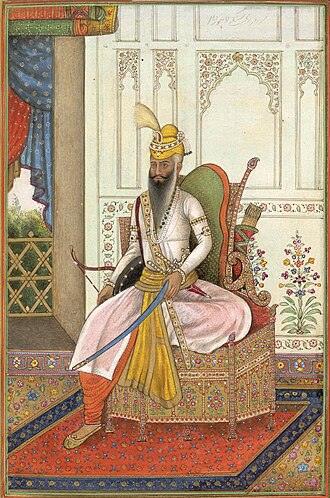
Maharaja Ranjit Singh
Founder of the Sikh state of the Punjab (Sarkar Khalsa), crowned at Lahore on 12 April 1801. Ruled until his death in 1839; the kingdom fell to the British in 1849.
Maharaja Ranjit Singh built the Sikh state of the Punjab, the Sarkar Khalsa, out of the quarrelling Sikh misls and ruled it from Lahore for nearly four decades. It was the last sovereign state of the Sikhs before the British annexation of 1849.
Early life. He was born on 13 November 1780 at Gujranwala, the son of Mahan Singh of the Sukkarchakkia misl and Raj Kaur, daughter of the Raja of Jind. He lost the sight of his left eye to smallpox in infancy and had no formal schooling. In 1796 he married Mahtab Kaur, daughter of Sada Kaur of the Kanhaiya misl.
Key moments
- 7 July 1799: at the age of 19 he drove the Bhangi chiefs out of Lahore.
- 12 April 1801 (Baisakhi): Sahib Singh Bedi applied the ceremonial mark and proclaimed him Maharaja of the Punjab. He refused royal emblems and a throne, and his coins bore the Guru's name.
- 1802: Amritsar came under his rule. He then took Multan (1818) and Kashmir (1819), and held Peshawar under direct control by 1834.
- 25 April 1809: the Treaty of Amritsar with the British, after the Metcalfe mission, fixed the Sutlej as the southern limit of his kingdom and left him free to expand north and west.
- 1822: he began to train his army on European lines with the French officers Allard (cavalry) and Ventura (infantry). At its peak the army numbered about 100,000.
- 27 June 1839: he died of paralysis at Lahore and was succeeded by his eldest son, Kharak Singh.
The state he ran. The Encyclopaedia of Sikhism describes about a dozen departments and four provinces (Lahore, Peshawar, Multan and Kashmir), ministers chosen largely on merit regardless of caste or creed, and land revenue capped at about half the gross produce. It describes him as a devout Sikh who thought of himself as a servant of the Guru. He paid for repairs to Muslim places of worship, there were no forced conversions, and men of different communities served in his council and army. The Tribune's review of a 2024 exhibition on him at the Wallace Collection in London called him "a powerful warrior, astute statesman, and flamboyant monarch of a cosmopolitan empire" and noted that much of what is known of his court comes from European travel accounts.
After him. Within ten years of his death, after two Anglo-Sikh wars, the British annexed the Punjab on 29 March 1849. Governor-General Dalhousie declared that the kingdom of the Punjab had ceased, and the young Maharaja Duleep Singh was made to sign away his crown and kingdom.
Remembered for: uniting the misls into one Sikh state that resisted Afghan and British pressure. His name is still invoked in Sikh politics: Baldev Singh Wadala announced the Sher-e-Punjab Dal in 2024 on the 185th anniversary of his death.
Sources
- Ranjit Singh (1780-1839), Encyclopaedia of Sikhism, Punjabi University, Patiala. eos.learnpunjabi.org
- Annexation of the Punjab, Encyclopaedia of Sikhism, Punjabi University, Patiala. eos.learnpunjabi.org
- Ranjit Singh's world: an exhibition in London traces his reign, The Tribune, 30 Jun 2024. tribuneindia.com
- Former Hazoori Ragi Baldev Singh Wadala steps into politics, announces formation of Sher-e-Punjab Dal, Yes Punjab, 28 Jun 2024. yespunjab.com