Person
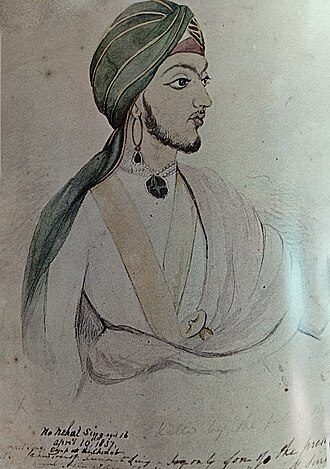
Kanwar Nau Nihal Singh
Grandson of Maharaja Ranjit Singh who ran the Lahore Darbar from late 1839. He died on 5 November 1840 when a gateway fell on him; accounts differ on whether it was an accident.
Kanwar Nau Nihal Singh was the son of Maharaja Kharak Singh and the favourite grandson of Maharaja Ranjit Singh, who gave much personal attention to his upbringing. He was born in February 1821 and died in November 1840, aged 19. For about a year he held the real power in the Lahore Darbar, and his death opened a succession struggle at Lahore.
Key moments
- 1834 to 1839: at barely 13 he took part in the Peshawar campaign of 1834, was put in charge of the Attock region, and the province of Peshawar was farmed out to him for Rs 12 lakh a year. In 1835 he put down a revolt in the Derajat and Tonk. In 1836 he went with his father to the Sindh border. In April 1839 he commanded a Sikh army sent to Peshawar to help Colonel Wade's force on its march through the Punjab to Kabul by the Khyber.
- 1837: he was married to the daughter of Sham Singh Attariwala, in a wedding of extraordinary splendour.
- 27 June 1839: Ranjit Singh died while Nau Nihal Singh was at Peshawar. He reached Lahore on 17 September and was drawn into court politics, where the Dogra brothers, Dhian Singh, Gulab Singh and Suchet Singh, gained influence over him.
- 9 October 1839: with the three Dogras he forced his way into the royal apartments. Dhian Singh killed Kharak Singh's favourite, Chet Singh, before the Maharaja, who was then in effect confined. Nau Nihal Singh took the government into his own hands.
- 5 November 1840: Kharak Singh died. The Encyclopaedia says contemporary chroniclers indicate he had been poisoned on Dhian Singh's orders after falling ill in March. The same day, as Nau Nihal Singh returned from the funeral rites, the northern gate of the Hazuri Bagh was brought down on him.
How he died: accounts differ. The Encyclopaedia says he suffered only minor injuries, was carried into the Fort in a palanquin kept ready beforehand, and had his head crushed with stones inside by Dhian Singh's men; it gives 8 November for his death. Wikipedia's summary of other accounts says that Alexander Gardner, close behind him, found him only slightly hurt, that the court physician Honigberger saw a crushed skull, and that the court hid the news for three days. It adds that the writer L. H. Griffin argued that Sher Singh's absence from Lahore that day pointed to Dhian Singh's innocence, and that Honigberger himself suspected partisans of Kharak Singh and Chet Singh. The cause of his death is not settled.
Afterwards: Kharak Singh's widow, Chand Kaur, who was also Nau Nihal Singh's mother, was proclaimed Maharani on 2 December 1840, and Sher Singh was proclaimed Maharaja on 18 January 1841. A contemporary Persian chronicler, quoted in the Encyclopaedia, lamented that with Nau Nihal Singh's death "glory departed from the Punjab".
Sources
- Nau Nihal Singh, Kanvar (1821-1840), The Encyclopaedia of Sikhism (ed. Harbans Singh), Punjabi University, Patiala (entry by Sardar Singh Bhatia). eos.learnpunjabi.org
- Dhian Singh, Raja (1796-1843), The Encyclopaedia of Sikhism (ed. Harbans Singh), Punjabi University, Patiala (entry by K. Jagjit Singh). eos.learnpunjabi.org
- Nau Nihal Singh (used for the other accounts of his death), Wikipedia. en.wikipedia.org