Person
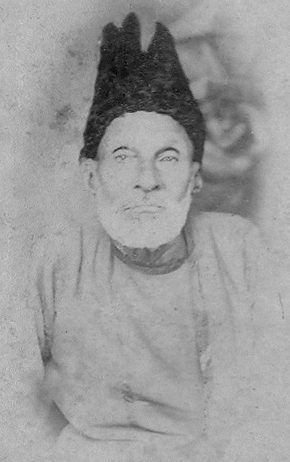
Mirza Ghalib
Urdu and Persian poet of Delhi whose 1857 diary Dastanbu records soldiers of the Maharaja of Patiala guarding his lane after the British retook the city.
Mirza Asadullah Beg Khan, known as Ghalib, was the great Urdu and Persian poet of Delhi in the last years of Mughal rule. He was born on 27 December 1797 at Agra, lost his father in battle at Alwar in 1803, married Umrao Begum in 1810 and settled in Delhi. In 1850 Bahadur Shah Zafar gave him the titles Dabir-ul-Mulk and Najm-ud-daula, and in 1854 he became the emperor's poetry tutor (Wikipedia). He belongs in a record of Punjab because of one passage of his 1857 diary.
Patiala's guard. Ghalib wrote Dastanbu, a Persian diary of Delhi from May 1857 to July 1858. In the translation by Ralph Russell and Khurshidul Islam, he describes his lane in Ballimaran, with its one exit and about a dozen houses, sealed off from inside after the British retook the city on 14 September 1857. The residents went about two days and nights without food or water, and on the third day a guard from Patiala arrived. Maharaja Narendar Singh of Patiala, the Sikh ruler of that state, had sided with the British from the start, and his troops fought beside them. Several of his favoured servants, the sons of Hakim Sharif Khan and prominent Delhi noblemen, lived in the lane, and he had asked the British commanders to guard it so that British soldiers would not harm the residents. On 5 October 1857 a small party of British soldiers climbed in over a wall, and the Patiala soldiers tried in vain to stop them. The soldiers took Ghalib to Colonel Burn's headquarters, where he was questioned courteously and released the same day.
The wider picture. Ghalib's own stance was to present himself as a loyal subject of the British, and the translators note that the diary may have been softened for British readers. A Tribune review of Shamsul Islam's Rebel Sikhs in 1857 says the Sikh rulers of Patiala, Jind, Nabha and Kapurthala supplied sepoys and war material to the British, while the book argues that many ordinary Sikh soldiers deserted to the rebels.
Key moments
- 27 December 1797: born at Agra.
- 1850: titles from Bahadur Shah Zafar.
- 14 September 1857: the British retake Delhi.
- 5 October 1857: questioned by Colonel Burn and released.
- 15 February 1869: dies in Delhi.
What he is remembered for. Ghalib is remembered as the foremost Urdu and Persian poet of his age, and the author of an eyewitness record of Delhi in 1857. He died on 15 February 1869 and is buried at Nizamuddin, near the tomb of Nizamuddin Auliya.
Sources
- Mirza Ghalib, Wikipedia. en.wikipedia.org
- Ghalib, 1797-1869, vol. 1: Life and Letters, ch. 6 (Dastanbu), translated by Ralph Russell and Khurshidul Islam, Harvard University Press, 1969; text on Frances Pritchett's site, Columbia University. franpritchett.com
- Mirza Ghalib's Dastanbuy (Mutiny Diary 1857-1858), excerpts, translated by Khwaja Ahmad Faruqi, Literature of Colonial South Asia, Lehigh University. scalar.lehigh.edu
- Review of Rebel Sikhs in 1857, by Shamsul Islam, The Tribune, 20 April 2008. tribuneindia.com
- Narinder Singh of Patiala, Wikipedia. en.wikipedia.org