Person
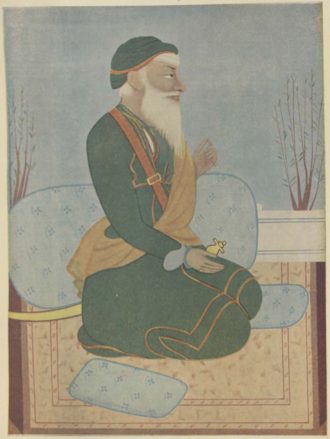
Dewan Mokham Chand
Khatri accountant who became Maharaja Ranjit Singh's de facto commander-in-chief from 1806 to 1814, taking the Cis-Sutlej and Jalandhar Doab, the hill states, and winning at Haidru in 1813.
Dewan Mokham Chand (spelled Muhkam Chand or Mohkam Chand in some sources) was one of the main architects of Maharaja Ranjit Singh's early conquests. He was born around 1750, the son of a small Khatri shopkeeper, Baisakhi Mall, from Kunjah in Gujrat district, now in Pakistan. He trained as an accountant, served as a munshi under several misl sardars, and rose to diwan under the Bhangi and Attariwala chiefs (Encyclopaedia of Sikhism).
In 1806 he joined Ranjit Singh as military and financial adviser. Until his death in 1814 he was the army's de facto commander-in-chief, and he played a major part in organising the Sikh army on a regular footing.
Key moments
- 1806: the Cis-Sutlej expedition brings Zira, Muktsar, Kot Kapura and Dharamkot, 102 villages, under Sikh control. In July he takes the estates of the two widows of Ilyas Khan of Raikot, 311 villages and towns including Ludhiana, Jagraon, Baddowal and Talwandi.
- 1807 and 1808: takes Naraingarh and Morinda, then Badhni and Patto. In 1808 he overruns the territory of the Faizullapuria misl and adds Jalandhar and Phillaur to the Maharaja's lands.
- 1809: a principal adviser in the talks with the British envoy Charles Metcalfe that led to the Treaty of Amritsar.
- 1810 to 1812: takes part in the battle of Multan in 1810; subdues Bhimber, Rajauri and Akhnur in 1811; reduces Mandi and Kulu in 1812. In the Kashmir expedition of 1812 he secures the release of Shah Shuja, the deposed king of Kabul, from Afghan custody and brings him to Lahore.
- 1813: inflicts a crushing defeat on the Afghans at Haidru when Fateh Khan, the wazir of Kabul, besieges Attock.
- 29 October 1814: dies at Phillaur and is deeply mourned by the Maharaja and the court. Wikipedia's infobox and lead disagree on the day, but its body agrees on 29 October.
Remembered for: building the army and the lands that the Maharaja held. He was paid in jagirs at Morinda, Faridkot, Sahnewal, Ambala and the Jalandhar Doab, worth more than seven lakh rupees a year, and the Encyclopaedia calls him an able administrator, especially in the Jalandhar Doab, where he earned wide popular praise. The Encyclopaedia names him as a Khatri who rose from a shopkeeper's son to the head of the Maharaja's army.
Sources
- Muhkam Chand Diwan (1750-1814), Encyclopaedia of Sikhism, Punjabi University, Patiala (eos.learnpunjabi.org). eos.learnpunjabi.org
- Mohkam Chand (for the differing death dates), Wikipedia. en.wikipedia.org