Person
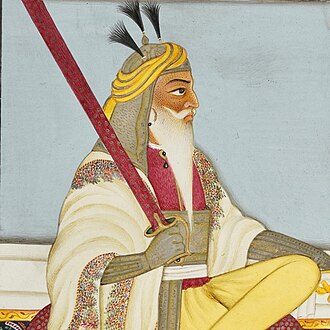
Sardar Hari Singh Nalwa
General of Maharaja Ranjit Singh's army on the western frontier. Governor of Kashmir and Hazara, took Peshawar in 1834, built the fort at Jamrud and died fighting the Afghans there on 30 April 1837.
Hari Singh Nalwa was the foremost general of Maharaja Ranjit Singh's army on the western frontier, a governor of Kashmir, Hazara and Peshawar, and the builder of the Sikh Empire's defences at the mouth of the Khyber Pass. He was born in April 1791 at Gujranwala. His father Gurdial Singh, a dera-dar in the Sukkarchakia misl, died when he was about seven, and his mother Dharam Kaur brought him up. His grandfather Hardas Singh had been killed fighting Ahmad Shah Durrani in 1762.
As a youth he killed a tiger that had seized him, which earned him the title Bagh-mar, "tiger-killer," and the name Nalwa. In 1805 he took a recruitment test, impressed the Maharaja, and was soon given command of 800 horse and foot.
Campaigns and governorships
- He fought at Kasur (1807), Sialkot, Shahiwal and Khushab (1809 to 1810), Attock (1813), in four of Ranjit Singh's campaigns against Multan between 1810 and 1818, and in Kashmir in 1814 and 1819.
- In 1820 he became governor of Kashmir. He divided the province into parganahs and thanas, built forts at Uri and Muzaffarabad and gurdwaras at Matan and Baramula, and organised relief after the floods of 1821. Ranjit Singh allowed him to strike a coin in his own name, the Harisinghi rupee.
- In 1822 he was given Hazara for fifteen years. He built the fort of Harikishangarh, named after the eighth Guru, and founded the town of Haripur beside it.
- In 1834 he took Peshawar and annexed it to the Sikh dominions. The Sikh Research Institute lists him as its governor from 1834 to 1836.
- In 1836 he built a fort at Jamrud, at the mouth of the Khyber Pass.
Jamrud, 30 April 1837. Afghan forces sent by Dost Muhammad Khan attacked the Sikh position at Jamrud. The Encyclopaedia of Sikhism records that he fought a fierce battle against the Afghans under Akbar Khan, took four gunshot wounds and two sabre cuts across the chest, and kept giving orders until a shot struck his side. He was taken into the fort and died that evening. His last instruction was to keep his death secret until the Maharaja's relief column arrived. Accounts of the fight differ. The Sikh Research Institute says Mahan Singh and 600 men were surrounded in Jamrud fort while Nalwa lay ill at Peshawar, and that he sent 10,000 soldiers to relieve them; an Afghan chronicle says he fell in a duel with Akbar Khan.
Key moments
- 1805: enters Ranjit Singh's service.
- 1820: governor of Kashmir.
- 1834: takes Peshawar.
- 30 April 1837: dies at Jamrud.
What he is remembered for. The Sikh Research Institute credits him with more than 55 buildings, among them forts at Jehangira, Nowshera, Sumergarh and Uri and Gurdwara Panja Sahib at Hasan Abdal, and with gold given for the dome of Sri Akal Takht Sahib. It adds that Pashtun mothers are said to have quieted their children with his name. Jamrud marked the western edge of the Sikh Empire when he died.
A contested record in Kashmir. Historians disagree about Sikh rule in Kashmir as a whole. Chitralekha Zutshi (2003) describes it as oppressive to the Muslim majority, citing restrictions such as on the call to prayer. Kapur and Singh (2001) present such measures as answers to calls for jihad and to Hindu grievances.
Sources
- Hari Singh Nalva (1791-1837), The Encyclopaedia of Sikhism (ed. Harbans Singh), Punjabi University, Patiala. eos.learnpunjabi.org
- Jamrud, The Encyclopaedia of Sikhism (ed. Harbans Singh), Punjabi University, Patiala. eos.learnpunjabi.org
- Hari Singh 'Nalua': Honorable Commander-in-Chief (Harinder Singh), Sikh Research Institute (SikhRI). sikhri.org
- Hari Singh Nalwa (Wikipedia, used only for the Afghan chronicle's account and the Kashmir historians' views), Wikipedia. en.wikipedia.org