Person
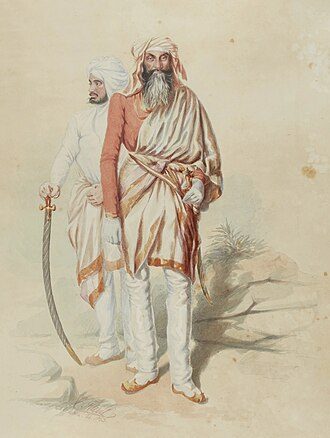
Sardar Chattar Singh Attariwala
Governor of Hazara whose dismissal in 1848 turned into a revolt and helped bring on the Second Anglo-Sikh War; held with his son Sher Singh until 1854 and died in Calcutta in 1855.
Sardar Chattar Singh Attariwala (the Encyclopaedia of Sikhism writes Chatar Singh Atariwala) was a leading Sardar of the Attariwala family and governor of Peshawar and then of Hazara under the Lahore Darbar. His dismissal and defiance in 1848 helped set off the Second Anglo-Sikh War. He died in Calcutta on 27 December 1855.
He was the son of Jodh Singh Attariwala, who joined Maharaja Ranjit Singh's service in 1805, and he inherited his large jagirs in the Pothohar country. He mostly farmed and stayed out of state affairs under Ranjit Singh. After Maharaja Sher Singh was assassinated in September 1843, his daughter Tej Kaur was betrothed to Maharaja Duleep Singh, which brought him political prominence (Encyclopaedia of Sikhism). Wikipedia adds that the British Resident, Sir Frederick Currie, did not honour the match.
Key moments
- August 1846: appointed governor of Peshawar. In November 1847 the Council of Regency recommended the title of Raja for him, but at his request it went to his son Sher Singh.
- 1848: transferred to Hazara, he clashed with Captain James Abbott over marking the boundary between the Punjab and the Kashmir territory the British had given to Raja Gulab Singh. In September 1848 Abbott alleged a conspiracy and charged him with high treason.
- Captain John Nicholson, sent by the Lahore Resident to investigate, exonerated him and justified his defensive measures. Currie disregarded the report and in effect dismissed him and confiscated his jagirs. That drove him to open defiance, and the Hazara revolt grew into war with the British.
- Sikh contingents at Bannu, Kohat, Peshawar, Attock and other garrisons revolted and joined him. His son Sher Singh's army fought the British at Chillianwala on 13 January 1849 and was heavily defeated at Gujrat on 21 February 1849.
- March 1849: Chattar Singh and Sher Singh surrendered to General Gilbert near Rawalpindi, on 12 March according to Wikipedia's account of the war and on 14 March according to the Encyclopaedia's entry on Sher Singh. From Abbott's charge to the surrender was about six months. The Punjab was then annexed.
- He and his sons were imprisoned at Allahabad, then moved to Fort William, Calcutta, to keep them from contact with the exiled Maharani Jind Kaur. They were released in January 1854 and banished from the Punjab (Wikipedia). Sher Singh died at Banaras in 1858.
He is remembered as the Sardar whose treatment by the Resident, against the findings of Nicholson's inquiry, drove him to revolt in the war that ended the Khalsa Raj.
Sources
- Chatar Singh Atarivala (d. 1855), Encyclopaedia of Sikhism, Punjabi University. eos.learnpunjabi.org
- Sher Singh Atarivala (d. 1858), Encyclopaedia of Sikhism, Punjabi University. eos.learnpunjabi.org
- Chattar Singh Attariwalla, Wikipedia. en.wikipedia.org
- Second Anglo-Sikh War, Wikipedia. en.wikipedia.org