Person
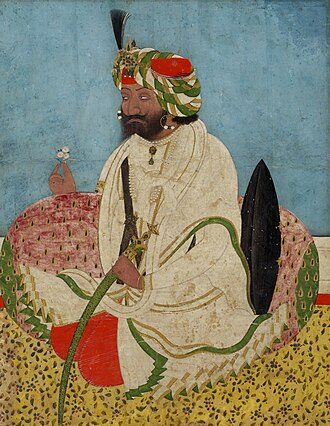
Raja Gulab Singh Dogra
Dogra courtier of Maharaja Ranjit Singh who passed intelligence to the British before the first Anglo-Sikh War and received Jammu and Kashmir in March 1846.
Gulab Singh was a Dogra Rajput of Jammu who rose in the service of Maharaja Ranjit Singh, was made Raja of Jammu, and became one of the most powerful men at the Lahore Darbar. In the first Anglo-Sikh War he kept faith with the British rather than with the Khalsa, and in March 1846 the British made him ruler of Jammu and Kashmir.
The Encyclopaedia of Sikhism, the main source here, records that he was born on 17 October 1792, the eldest son of Mian Kishora Singh Dogra. He joined Ranjit Singh's army in 1809 as a trooper on three rupees a day. His father was named chief of Jammu in 1820, and when Kishora Singh died in 1822 the Maharaja gave the title to Gulab Singh at a ceremony at Akhnur on 16 June 1822. He served in campaigns in the Punjab hills and Kashmir and became the most highly favoured financial vassal of the Sikh State. While the Maharaja lived he stayed humble and leaned on his brother Raja Dhian Singh. The Encyclopaedia adds that he had eyes on Kashmir from 1836 and had taken over several hill states that paid tribute to the Sikhs.
Key moments
- 1841: he became custodian of the jagirs of Kharak Singh's widow, Chand Kaur. The Encyclopaedia says he carted all her jewellery and valuables off to Jammu and misappropriated them.
- 1845: the Khalsa army sent 35,000 men against him at Jammu over his intrigues. He was brought to Lahore as a hostage and let go on promising a fine of 68 lakh rupees.
- On the eve of the first Anglo-Sikh War he kept contact with the British and passed military intelligence to Brigadier Wheeler at Ludhiana. The Encyclopaedia says the British rewarded him for this secret help.
- Early 1846: after the Khalsa's defeat, Governor-General Hardinge chose to negotiate with him alone. Kashmir Life, in an article by historian Ashiq Hussain Bhat, says Rani Jindan had appointed him chief minister in the crisis.
- 15 March 1846: he was invested as Maharaja. On 16 March the Treaty of Amritsar recognised him as ruler of the hill country between the Indus and the Ravi, for seventy-five lakh Nanakshahi rupees. He acknowledged British supremacy, agreed to refer disputes with Lahore to the British, and to join British troops with his whole force when they were employed in the hills.
- 30 June 1857: he died at Jammu.
The sale of Kashmir was attacked at the time. In England Lord Ripon and Sir James Weir Hogg, Chairman of the East India Company, objected to it, and Lord Ellenborough condemned it as a reward for Gulab Singh's treachery towards the Sikhs. Hardinge defended the treaty. Gulab Singh, he said, had done the British good service even before the war, and after it began they could not abandon their policy and treat with indifference the only man who had not lifted his arm against them. He argued that the charge of treason could not be substantiated.
Sources
- GULAB SINGH (1792-1857), The Encyclopaedia of Sikhism (Punjabi University, Patiala). eos.learnpunjabi.org
- TREATY WITH GULAB SINGH, The Encyclopaedia of Sikhism (Punjabi University, Patiala). eos.learnpunjabi.org
- The Day Kashmir Was Sold, Kashmir Life (Ashiq Hussain Bhat, 17 March 2013). kashmirlife.net