Person
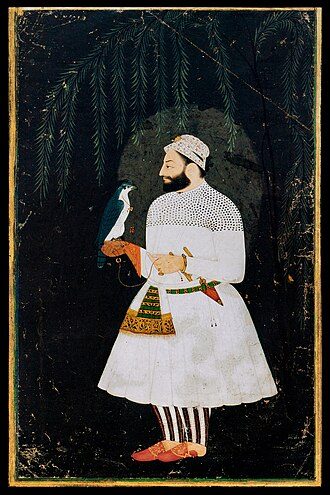
Guru Hargobind Sahib Ji
The sixth Guru. He wore two swords at his installation in 1606, raised the Akal Takht, was held at Gwalior, and is remembered as Bandi Chhor, the liberator.
Guru Hargobind was born on 19 June 1595 at Vadali, near Amritsar, the only son of Guru Arjan and Mata Ganga, according to the Encyclopaedia of Sikhism. Bhai Gurdas taught him the sacred texts, and Baba Buddha taught him swordsmanship and archery. Guru Arjan named him successor on 25 May 1606. The Encyclopaedia links what followed to Guru Arjan's execution in 1606 under Emperor Jahangir. At his installation on 24 June 1606 he sat before the Harimandar wearing two swords, one for spiritual authority (piri) and one for temporal authority (miri).
Key moments
- 15 June 1606: the Akal Takht is raised opposite the Harimandar. The Encyclopaedia takes this date from the Gurbilas Patshahi Chhevin, which it calls the oldest account of his life. The Guru laid the first stone, and Baba Buddha and Bhai Gurdas completed it, no third person being allowed to help.
- From 1606: he issued hukamnamas asking the sangats to bring horses and weapons as offerings, and kept a retinue of fifty-two armed Sikhs.
- About 1617 to 1619: Jahangir had him held in the fort at Gwalior. The Dabistan-i-Mazahib says the charge was an unpaid fine imposed on his father. How long he was held is uncertain: sources give anything from forty days to twelve years, and the Encyclopaedia thinks a few months between 1617 and 1619, followed by a period under watch in the royal camp.
- 4 October 1621: at Hargobindpur, troops sent by the Jalandhar governor are repulsed.
- 14 April 1634: the battle of Amritsar, in which the Lahore governor Mukhlis Khan is killed near the site of Khalsa College. Clashes follow at Lahira on 16 December 1634 and at Kartarpur on 26 and 27 April 1635.
- 1635 to 1644: he settles at Kiratpur, where he spends his last nine years in peace.
Bandi Chhor. Sikh tradition says he agreed to leave Gwalior only if the other prisoners were freed with him, and led fifty-two of them out. The Encyclopaedia records the title Bandichhor, the Liberator, and the lights and fireworks with which the anniversary is still marked at the Golden Temple. It presents the number fifty-two as part of that tradition, without independent verification.
Death. He died at Kiratpur on 3 March 1644, the date the Encyclopaedia gives (some modern accounts say 28 February), and was cremated on the bank of the Sutlej, where Gurdwara Patalpuri stands. His sons included Guru Tegh Bahadur, the ninth Guru.
Remembered for. The Encyclopaedia says the idea of miri-piri, the link between temporal and spiritual authority, is usually associated with him, though its roots go back to Guru Nanak's teaching that the world is real and must be engaged with. It adds that miri-piri does not mean a theocracy, since Sikhism has no priestly hierarchy. The Akal Takht is the primary seat of Sikh religious authority, where Sarbat Khalsa assemblies were traditionally held and whose decrees apply to all Sikhs and Sikh institutions.
Sources
- Hargobind, Guru (1595-1644), The Encyclopaedia of Sikhism (ed. Harbans Singh), Punjabi University, Patiala. eos.learnpunjabi.org
- Akal Takht, The Encyclopaedia of Sikhism (ed. Harbans Singh), Punjabi University, Patiala. eos.learnpunjabi.org
- Miri-Piri, The Encyclopaedia of Sikhism (ed. Harbans Singh), Punjabi University, Patiala. eos.learnpunjabi.org
- Guru Hargobind, Wikipedia. en.wikipedia.org
- Bittu favours release of Bandi Singhs; BJP goes all out to woo Sikh electorate, The Tribune. tribuneindia.com