Person
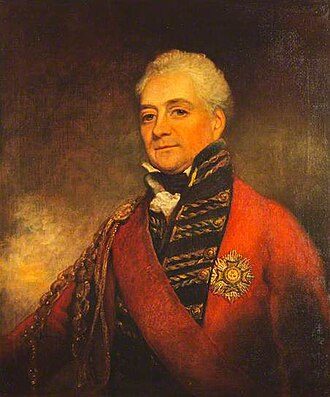
David Ochterlony
East India Company officer who advanced to the Sutlej in 1808 and was agent at Ludhiana from 1809 to 1814; his advance backed Metcalfe's treaty and fixed the river as Ranjit Singh's limit.
Sir David Ochterlony (1758 to 1825) was the East India Company officer who held the Sutlej line against Maharaja Ranjit Singh. Born in Boston, Massachusetts, on 12 February 1758, he went to India as a cadet in 1777 and served in the Maratha wars, becoming Resident at Delhi in 1803. He was made lieutenant colonel in early 1803 (Wikipedia) and was promoted colonel only in January 1812 and major-general in June 1814 (Encyclopaedia of Sikhism), so he was a lieutenant colonel in 1808 and 1809, although the Encyclopaedia's entry on the treaty calls him Colonel. In 1808 he was ordered to advance to the Sutlej with a detachment, and from 1809 to 1814 he was the Governor-General's agent at the Ludhiana Political Agency, the Company's watch-post over the Cis-Sutlej Sikh chiefs.
Key moments
- September 1808: Charles Metcalfe meets Ranjit Singh at Khem Karan with a draft treaty, which Ranjit Singh rejects. He then crosses the Sutlej and overruns the left bank.
- 1808 to 1809: a force under Ochterlony passes through Patiala and stations itself at Ludhiana, close to the river. Ranjit Singh answers by moving troops and guns towards Phillaur and mounting guns at Gobindgarh Fort in Amritsar.
- 9 February 1809: Ochterlony declares that further Sikh incursions south of the Sutlej will be met with British aggression (Wikipedia, citing the Cambridge History of India).
- 25 April 1809: the Treaty of Amritsar is signed. It was ratified on 30 May.
- 12 June 1809: he announces to the Cis-Sutlej chiefs that they are under British protection (Wikipedia, citing Hari Ram Gupta).
- 1809: he compiles his Report on the Sikh Country, describing the power, revenue and military resources of the Cis-Sutlej Sikhs, Ranjit Singh's three Malwa campaigns, and ways to curb his influence.
After Ludhiana he commanded one of four columns in the Anglo-Nepalese War of 1814 to 1816 and obtained the Treaty of Sugauli. He received a baronetcy and the Grand Cross of the Bath, was Resident in Rajputana from 1818 and later at Malwa, and resigned in 1825 after Lord Amherst repudiated his support for the young Raja at Bharatpur. He died at Meerut in July 1825; Wikipedia gives 14 July and the Encyclopaedia of Sikhism 15 July.
The Encyclopaedia of Sikhism judges that he overestimated his authority and did not establish the amicable relations the Treaty of Amritsar required, and says his Ludhiana despatches show an unreasonable preoccupation with Ranjit Singh's expansion.
He is remembered in Punjab history as the soldier whose presence at Ludhiana gave force to the Sutlej boundary and made the Cis-Sutlej chiefs clients of the Company.
Sources
- Ochterlony, Sir David (1758-1825), The Encyclopaedia of Sikhism (ed. Harbans Singh), Punjabi University, Patiala (web edition at thesikhencyclopedia.com). thesikhencyclopedia.com
- Anglo-Sikh Treaty (Treaty of Amritsar, 1809), The Encyclopaedia of Sikhism (ed. Harbans Singh), Punjabi University, Patiala (web edition at thesikhencyclopedia.com). thesikhencyclopedia.com
- Treaty of Amritsar (1809) (the 9 February and 12 June 1809 announcements), Wikipedia (used because no better source loaded). en.wikipedia.org
- David Ochterlony (later career, honours and death), Wikipedia (used because no better source loaded). en.wikipedia.org