Person
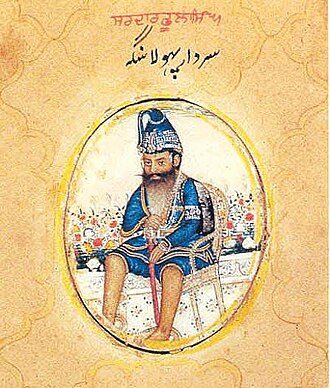
Akali Phoola Singh
Nihang leader and custodian of Sri Akal Takht Sahib under Maharaja Ranjit Singh. He summoned the Maharaja to answer for a lapse, led the Akalis at Multan and Kashmir, and fell at Naushehra in 1823.
Akali Phoola Singh was the best known Nihang leader of the Sikh Raj. The Encyclopaedia of Sikhism calls him the leader of the Akali Nihangs and the custodian of Sri Akal Takht Sahib, the voice of the religious and moral conscience of the State, who at times censured the Sovereign himself. He also commanded the Akali troops in Maharaja Ranjit Singh's army, the most daring of the Maharaja's soldiers, and he died leading them at Naushehra.
Early life. He was born in 1761 at Shihan, a village now in ruins about 5 km west of Munak in Sangrur district. His father, Ishar Singh, an associate of the Nishanwali misl, died in 1762 fighting Ahmad Shah Durrani in the Vadda Ghallughara. The infant was raised by Baba Naina Singh of the Shahid misl, who taught him the Sikh texts and the methods of warfare and gave him the Khande di Pahul. After Naina Singh's death Phoola Singh was elected leader of the jatha.
Key moments
- 1800: he moved with his jatha to Amritsar, troubled by the way the Sikh shrines were being run.
- January 1802: when Ranjit Singh attacked Amritsar to take it from the Bhangis, Phoola Singh mediated between the two sides and averted bloodshed. He took charge of the shrines and began levying charges on the sardars and officials of the court for their upkeep.
- As provost of Akal Bunga, the Akal Takht, he summoned Ranjit Singh over a moral misdemeanour. The Maharaja answered the summons and accepted the penalty the Takht laid on him.
- 1807 to 1819: his Akalis fought at Kasur in 1807, were the storming party at Multan, which fell in the final assault of 1818, and took part in the Peshawar campaign of 1818 and the Kashmir campaign of 1819. After Kasur the Maharaja gave his force barracks at Amritsar, which grew into the Akali Cantonment, the headquarters of the Nihang sect.
- 14 March 1823, Naushehra: Amir Muhammad Azim Khan marched from Kabul to take Peshawar, and a Sikh army under Prince Kharak Singh met him at Naushehra. The 1,500 Akalis made a desperate charge. Phoola Singh's horse was shot under him; he moved to an elephant and pressed on, and the Afghan militia made him their main target. He fell under a heavy shower of bullets, with most of his men, but the battle was won and the Afghans fled.
What he is remembered for. He was cremated with full military honours at Pirsibaq, 6 km east of Naushehra, where a samadh was built and the Maharaja attached a jagir to it. Another monument, Burj Baba Phoola Singh, stands in Amritsar. The Encyclopaedia's entry on Sri Akal Takht Sahib cites the Maharaja's answer to Phoola Singh's summons as an instance of the State showing subservience to the Takht's religious authority.
Sources
- Phula Singh Akali (1761-1823), The Encyclopaedia of Sikhism (ed. Harbans Singh), Punjabi University, Patiala. eos.learnpunjabi.org
- Nihangs, The Encyclopaedia of Sikhism (ed. Harbans Singh), Punjabi University, Patiala. eos.learnpunjabi.org
- Akal Takht, The Encyclopaedia of Sikhism (ed. Harbans Singh), Punjabi University, Patiala. eos.learnpunjabi.org