Person
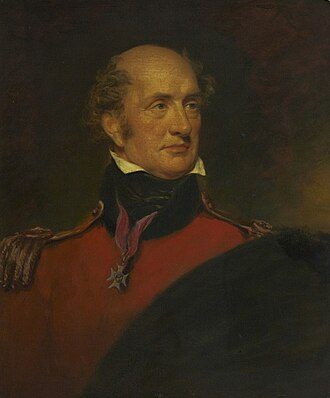
Sir John Malcolm
East India Company officer who concluded the 1806 treaty with the Sikh chiefs and wrote Sketch of the Sikhs (1812), the first British account to treat Sikh scripture as a key source.
Sir John Malcolm (1769 to 1833) was a Scottish soldier, diplomat and historian in the service of the East India Company. He joined the Company's army at thirteen, served as envoy to Persia and as Resident at Indian courts, and later governed Bombay. In Sikh history he stands for two things: a treaty and a book.
The treaty. In 1805 Malcolm was with Lord Lake's army when the Maratha chief Jaswant Rao Holkar took refuge in the Punjab. The Encyclopaedia of Sikhism gives the text of the Anglo-Sikh treaty of 1 January 1806 and says Lieutenant Colonel Malcolm concluded its articles under special authority from Lord Lake. Sardar Fateh Singh Ahluwalia signed for himself and as plenipotentiary for Ranjit Singh. The Sikh chiefs agreed to make Holkar withdraw at least 30 coss (about 60 miles) from Amritsar and to cut all ties with him. The British agreed to move their army off the Beas and not to enter the chiefs' territories or seize their property, as long as the chiefs kept out of friendly dealings with Britain's enemies.
The book. Sketch of the Sikhs first appeared in Asiatick Researches in 1810 and as a book in 1812. The Encyclopaedia says he was the first British writer to treat the Guru Granth Sahib, the Dasam Granth, the Janam Sakhis and Bhai Gurdas's Vars as key sources, in preference to Muslim chronicles. John Leyden translated Gurmukhi manuscripts for him and a Nirmala Sikh in Calcutta helped with scripture. For the early eighteenth century he leaned mainly on Ghulam Husain Khan's Siyar al-Mutakherin, and he admitted his account was hasty and sketchy.
Key moments
- 2 May 1769: born at Burnfoot, Dumfriesshire.
- 1782 to 1783: joins the Company's army and reaches Madras.
- 1799 to 1801: envoy to Persia.
- 1805: serves with Lord Lake and makes treaties with Sindia and Holkar.
- 1 January 1806: concludes the treaty with the Sikh chiefs.
- 1812: Sketch of the Sikhs published in book form.
- 1827 to 1830: Governor of Bombay.
- 1833: dies; a statue by Chantrey stands in Westminster Abbey.
How to read him. The Encyclopaedia (entry by J. S. Grewal) calls the book impressionistic and partly pejorative, but useful when read critically. It says Malcolm wrongly treated Sikhism as a reform movement within Hinduism and underrated Guru Gobind Singh, yet his notes on administration, revenue and the disunity of the Sikh chiefs are valuable. He wrote as an officer of the power that would annex the Punjab in 1849.
Sources
- SKETCH OF THE SIKHS (entry by J. S. Grewal), The Encyclopaedia of Sikhism (Punjabi University, Patiala). eos.learnpunjabi.org
- ANGLO-SIKH TREATY (1806), The Encyclopaedia of Sikhism (Punjabi University, Patiala). eos.learnpunjabi.org
- MALCOLM, John (career and dates, drawn from the Dictionary of National Biography), Who Was Who in Indology. whowaswho-indology.info