Person
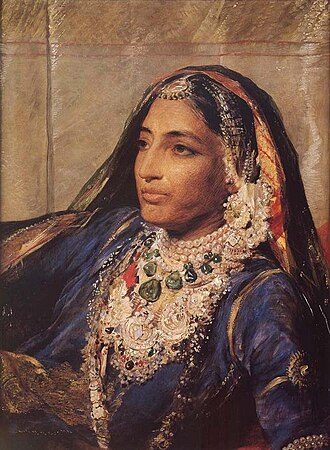
Maharani Jind Kaur
Wife of Maharaja Ranjit Singh and mother of Duleep Singh. Regent of the Sikh Empire from 1843, she was imprisoned by the British, escaped to Nepal in 1849 and died in London in 1863.
Maharani Jind Kaur, known as Jindan, was the wife of Maharaja Ranjit Singh and the mother of Maharaja Duleep Singh, the last sovereign of the Sikh Empire. She ruled as regent in his name from 1843 until the British removed her from power, and later imprisoned and exiled her.
She was born about 1817, the daughter of Manna Singh Aulakh, overseer of the royal kennels. She married Ranjit Singh around 1835 and bore Duleep Singh in 1838. Ranjit Singh died in 1839, and the throne passed through a series of assassinations. After Maharaja Sher Singh and Dhian Singh were assassinated in September 1843, the Khalsa army proclaimed five-year-old Duleep Singh sovereign on 16 September 1843, and she became regent. The army panchayats addressed her as "Mai Sahib."
Key moments
- 16 September 1843: becomes regent.
- December 1845: the First Anglo-Sikh War begins.
- December 1846: the Treaty of Bhairowal removes her from power.
- August 1847: imprisoned at Lahore Fort, then sent to Sheikhupura.
- 19 April 1849: escapes from Chunar fort; reaches Kathmandu on 29 April.
- 1 August 1863: dies at Kensington, London.
The war and the removal. The Encyclopaedia of Sikhism argues that British policy and frontier actions, not she, drove the First Anglo-Sikh War, and singles her out as the leader who showed determination and courage. Lord Ellenborough called her "the only person apparently at Lahore, who has courage." After the Treaty of Bhairowal she gave up power to a council of ministers under the British Resident and was pensioned off. In August 1847, suspected of opposing the investiture of Tej Singh as Raja of Sialkot, she was imprisoned in Lahore Fort on Henry Lawrence's orders. She was moved to Sheikhupura in September 1847, her allowance was cut to Rs 48,000, and she was later held under watch at Benares.
1849: Chunar and Nepal. She was moved to the state prison at Chunar fort near Varanasi. Amarpal Singh dates the move to 6 April 1849, eight days after the annexation of Punjab on 29 March. He writes that her intercepted letters, sent to the government on 19 March, ten days before the annexation, gave the British their excuse. The Sikh Research Institute places the move in 1848. On 19 April 1849 she escaped, dressed as a servant while a maid took her place in the cell. She travelled about 480 km disguised as a pilgrim and reached Kathmandu on 29 April 1849. Jung Bahadur Rana gave her asylum out of respect for Ranjit Singh, and she lived in Nepal until 1860. The British confiscated her jewellery and stopped her pension. From Nepal she tried to reach rebels in Punjab and wrote to Gulab Singh about entering Kashmir, but the British pressed Nepal to restrict her.
Reunion and death. Duleep Singh had been converted to Christianity and sent to Britain. She met him in Calcutta in April 1861 and sailed with him to England in May. The Sikh Research Institute credits her with reinforcing his Sikh heritage. She died at Kensington on 1 August 1863 and was first interred at Kensal Green Cemetery.
How she is remembered. British writers called her "the Messalina of the Punjab." Lord Dalhousie wrote in January 1849 that she "has the only manly understanding in the Punjab," and said she was "worth more than all the soldiers of the state put together for any purpose of mischief." The Sikh Museum Initiative reads the first remark as a sign that he thought her too powerful to be allowed back in the Punjab.
Sources
- Jind Kaur, Maharani (1817-1863), The Encyclopaedia of Sikhism (ed. Harbans Singh), Punjabi University, Patiala. eos.learnpunjabi.org
- Maharani Jind Kaur (Surender Pal Singh), Sikh Research Institute (SikhRI). sikhri.org
- Maharani Jindan Kaur: the queen with the only manly understanding in the Punjab, Sikh Museum Initiative. sikhmuseum.org.uk
- How the British detained Maharani Jind Kaur and how she escaped (excerpt from The Second Anglo-Sikh War by Amarpal Singh), Scroll.in. scroll.in
- Annexation of the Punjab (Dalhousie's step of 29 March 1849), The Encyclopaedia of Sikhism (Punjabi University, Patiala). eos.learnpunjabi.org