Person
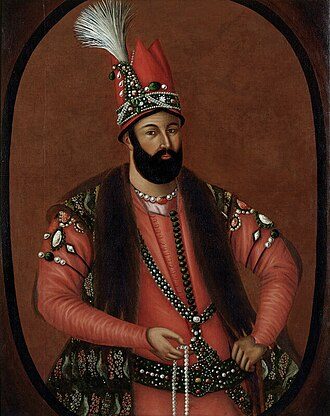
Nader Shah
Persian conqueror who sacked Delhi in 1739 and exposed Mughal weakness in Punjab; on his way home Sikh bands plundered his baggage train and freed captives.
Nader Shah (about 1688 to 1747) was the Persian soldier-king who founded the Afsharid dynasty and, in 1739, invaded the Mughal empire and sacked Delhi. For Punjab his invasion is the moment the Mughal hold on the province was shown to be hollow, and the occasion on which, in Sikh tradition, Sikh bands struck a foreign army's baggage train.
Wikipedia gives his birth as 1688 (some sources say 1698) in Khorasan, and says he rose as a soldier under the Safavid shah Tahmasp II, deposed the infant Abbas III and was crowned Shah of Iran on 8 March 1736. In 1738 he took Kandahar and then came through the Khyber Pass, passed Lahore and crossed the Indus.
Key moments
- Early 1739: he defeats the Mughal army at Karnal. Sources date the battle anywhere from January to February.
- March 1739: he enters Delhi. After a rumour of his death sparks attacks on his troops, he orders a sack of the city on 22 March. Wikipedia puts the dead at 20,000 to 30,000 in one day and says up to 10,000 women and children were enslaved. Dawn's reviewer writes of about 30,000. A 2023 Tribune article repeats a much higher figure, over two lakh, which it presents only as hearsay.
- May 1739: he leaves with the Peacock Throne and the Koh-i-Noor, loot Wikipedia values at up to 700 million rupees. The Tribune (2000) says he set out on 5 May.
- Summer 1739: on his way back through Punjab, Sikh bands harass his baggage train. The Encyclopaedia of Sikhism says the Taruna Dal plundered the "richly laden" train and, at Akhnur on the Chenab, rescued a large number of Hindu girls and returned them to their families. Wikipedia says Sikhs seized part of the booty and freed many captives in the Chenab valley, and that Zakariya Khan, the governor of Lahore, accompanied him back to his forces.
- 20 June 1747: he is killed at Quchan in Khorasan during a rebellion. Ahmad Khan, who had commanded Nader's Abdali contingent and gone with him to India in 1739, leads the Afghan soldiers to Kandahar and is chosen as Ahmad Shah, later called Abdali or Durrani.
A caution on the Sikh episode: the Encyclopaedia of Sikhism notes that the Tazkirah of Anand Ram Mukhlis, an eye-witness who served the Mughal court, describes the invasion in detail but has no reference to the Sikhs attacking the baggage train. The attack rests on Sikh tradition and later sources.
Remembered for: the Delhi massacre and the plunder of the Mughal treasury, and in Sikh memory as the invader whose homeward column the Sikhs harassed. His death opened the way for Ahmad Shah Abdali, who, the Tribune says, took the Koh-i-Noor from Nader's tent after the assassination, and who made the first of his invasions of Punjab in 1748.
Sources
- Nader Shah, Wikipedia (used for dates and the Delhi sack; Britannica and Iranica would not load). en.wikipedia.org
- Taruna Dal, The Sikh Encyclopedia (web edition of the Encyclopaedia of Sikhism). thesikhencyclopedia.com
- Tazkirah (lit. memoir), The Encyclopaedia of Sikhism (ed. Harbans Singh), Punjabi University, Patiala. eos.learnpunjabi.org
- Ahmad Shah Durrani, The Sikh Encyclopedia (web edition of the Encyclopaedia of Sikhism). thesikhencyclopedia.com
- The scourge of Delhi (Irfan Husain, 24 January 2009), Dawn. dawn.com
- This Diamond Is Forever (Gurmukh Singh Sandhu, 9 July 2000), The Sunday Tribune. tribuneindia.com
- How the famed Koh-i-Noor kept changing hands (June 2023), The Tribune. tribuneindia.com