Person
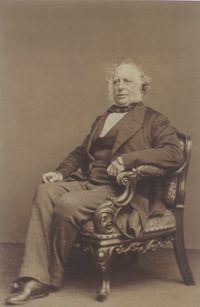
Sir Frederick Currie
East India Company official who negotiated the 1846 treaties with the Lahore Darbar, was Resident at Lahore when Multan rose in 1848, and later chaired the Company at its end.
Sir Frederick Currie was an East India Company civil servant who stood at three turning points in the fall of the Sikh Raj: the settlement after the First Anglo-Sikh War, the Multan revolt of 1848 and the annexation of Punjab in 1849. He was born in Bloomsbury, London, on 3 February 1799 and reached Bengal in 1820. As Foreign Secretary to the Government of India he stayed at Governor-General Lord Hardinge's side through the war of 1845 to 1846.
Key moments
- 1845: the Encyclopaedia of Sikhism says he supported Major George Broadfoot's action on the Sutlej, which it describes as a virtual seizure of Lahore territory on the left bank of the river.
- March 1846: he led the negotiations for the Treaty of Lahore, though Wikipedia notes he did not determine its terms. With Henry Lawrence he also signed the Treaty of Amritsar of 16 March 1846, under which Kashmir was sold to Gulab Singh. He was made a baronet in January 1847.
- 16 December 1846: the Treaty of Bhyroval. The Encyclopaedia says Currie isolated Maharani Jind Kaur and manipulated the leading sardars into asking for a new treaty. It put a British Resident in full control of the Lahore Darbar during Maharaja Duleep Singh's minority and pensioned off the Maharani.
- March 1848: he replaced Henry Lawrence, who was on sick leave, as Resident at Lahore.
- April 1848: after Diwan Mulraj of Multan resigned over an increased levy, Currie named Sardar Kahn Singh Man to replace him and sent two British officers, Vans Agnew and Anderson. They were killed and Mulraj rose in revolt. Lord Dalhousie rebuked Currie for sending what he called an "avowedly disloyal force", and the Encyclopaedia says Dalhousie's wish for a full campaign shaped Currie's instructions to keep Herbert Edwardes away from Multan.
- 1848: he expelled Maharani Jind Kaur from Punjab on what the Encyclopaedia calls a fictitious plot, cutting her allowance to a third. Wikipedia says his orders against Chattar Singh Attariwala angered Chattar Singh's son Sher Singh, who changed sides on 13 September 1848.
- 1849: after the battle of Gujrat the Punjab was annexed on 29 March. Wikipedia says Currie had asked for troops to protect the young Maharaja and protested, with Lawrence, against Dalhousie's decision to end the Lahore government and exile Duleep Singh.
He returned to England in 1853, became a director of the East India Company in 1854 and was elected its chairman in 1857, the last person to hold that office. He died at St Leonards, Sussex, on 11 September 1875.
Remembered for: running the Lahore Residency as the Darbar was dismantled. The Encyclopaedia records that his handling of Multan drew hostile criticism in Britain, which Dalhousie answered in a long despatch defending him.
Sources
- CURRIE, SIR FREDERICK (1799-1875), The Encyclopaedia of Sikhism (Punjabi University, Patiala). eos.learnpunjabi.org
- ANGLO-SIKH TREATY (BHYROWAL or BHAROVAL, December 1846), The Encyclopaedia of Sikhism (Punjabi University, Patiala). eos.learnpunjabi.org
- Sir Frederick Currie, 1st Baronet, Wikipedia (used for the treaty negotiations, the Multan events and his later career, which the Encyclopaedia entry covers only briefly). en.wikipedia.org