Person
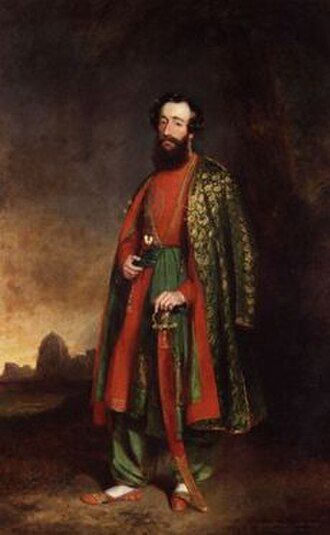
Sir Herbert Edwardes
British political officer who raised an irregular force against Dewan Mulraj at Multan in 1848, the first British answer to the revolt that grew into the Second Anglo-Sikh War.
Sir Herbert Benjamin Edwardes (1819 to 1868) was an East India Company officer and political agent in the Punjab. Born at Frodesley in Shropshire, he joined the Bengal Infantry in 1841. In the First Anglo-Sikh War he was aide-de-camp to Sir Hugh Gough, was wounded at Mudki on 18 December 1845 and fought at Sobraon. Afterwards Henry Lawrence made him an Assistant Resident, and in February 1847 he became Political Agent at Bannu, where he demolished forts, built roads and canals, and settled feuds. The town was named Edwardesabad after him.
His part in this history is Multan. Dewan Mulraj governed it for the Lahore Darbar, and the British officers Patrick Vans Agnew and William Anderson were sent to take over from him. They were attacked on 18 April 1848 and murdered the next day. The revolt that followed widened into the Second Anglo-Sikh War.
Key moments
- April to July 1848: Edwardes raised armed tribesmen largely on his own initiative, with no British troops and little money. He won the support of the Nawab of Bahawalpur and was authorised by Lahore on 10 June to act on his own judgment. He defeated Mulraj's men at Kineyri on 18 June and at Sadusam on 3 July (another account gives 1 July), and Mulraj retreated into Multan fort.
- September 1848: General Whish's siege of Multan was lifted on 22 September after Sher Singh Attariwala's army rebelled on 14 September. Whish renewed the siege on 27 December with 17,000 men and stormed the city on 2 January 1849.
- 22 January 1849: Mulraj surrendered the citadel after negotiations that Edwardes directed. The British lost 210 killed and 910 wounded at Multan.
- 1849 to 1851: he received the Order of the Bath in October 1849, an honorary Oxford degree in June 1850, and wrote A Year on the Punjab Frontier.
- 1853 to 1859: commissioner at Peshawar from October 1853. He urged a treaty with Amir Dost Muhammad, signed on 30 March 1855, and in 1857 pressed for reinforcements for Peshawar and helped raise Punjab troops.
He later served at Ambala, left India for good on 1 January 1865 and died in London on 23 December 1868, aged 49. Henry Lawrence said that since the days of Clive no man had done as Edwardes.
Remembered for: the Multan campaign. Lawrence's praise is the usual British verdict on it, and the Multan rising was the start of the Second Anglo-Sikh War, which ended the Sikh kingdom in 1849.
Sources
- Edwardes, Herbert Benjamin (Dictionary of National Biography, 1889), Wikisource. en.wikisource.org
- Herbert Edwardes, Wikipedia. en.wikipedia.org
- Second Anglo-Sikh War, Wikipedia. en.wikipedia.org