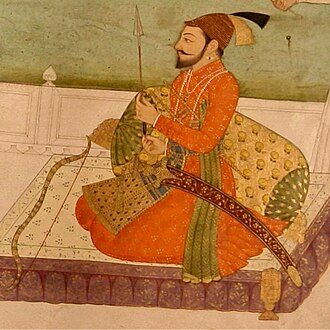
Guru Gobind Singh Ji
ਗੁਰੂ ਗੋਬਿੰਦ ਸਿੰਘ ਜੀ
Tenth Guru of the Sikhs. Created the Khalsa at Anandpur on Baisakhi 1699, lost his four sons in 1705, and in 1708 declared the Guru Granth Sahib his successor.
Guru Gobind Singh Ji was the tenth Guru of the Sikhs. He created the Khalsa at Anandpur on Baisakhi 1699, fought the hill rajas and the Mughal armies, lost his four sons, and before his death in 1708 declared the Guru Granth Sahib the Guru of the Panth.
Birth and succession. He was born Gobind Rai on 22 December 1666 at Patna, the son of Guru Tegh Bahadur and Mata Gujari, and reached Anandpur in March 1672. In 1675 Kashmiri Pandits came to Guru Tegh Bahadur at Anandpur to describe the persecution under the Mughal governor Iftikhar Khan. On 8 July 1675 the Guru named his son as his successor. Guru Tegh Bahadur was beheaded in public at Chandni Chowk, Delhi, on 11 November 1675 after refusing both to accept Islam and to perform a miracle. Gobind Rai, about nine years old, was formally installed as Guru on Baisakhi, 29 March 1676.
Key moments
- 1684: composed the Var Sri Bhagauti Ji Ki (Chandi di Var), his first work and his only major Punjabi one. Later works include Jaap, Akal Ustati and Bachitar Natak.
- 18 September 1688 at Bhangani, 20 March 1691 at Nadaun and 20 February 1696 at Husaini: battles against the hill rajas and Mughal commanders.
- Shortly before 1699: he abolished the masands, the intermediaries between the Guru and the sangats.
- 30 March 1699 (Baisakhi) at Anandpur: he called for volunteers to offer their heads. Five came forward and were initiated with amrit stirred with a double-edged sword, and were named Singhs. They became the Panj Pyare, and members of the Khalsa were to wear the five Ks. The Guru then took initiation from the Panj Pyare and became Gobind Singh.
- May to December 1705: hill rulers and Mughal forces besieged Anandpur. On the night of 5 to 6 December the Sikhs left after the besiegers swore oaths of safe passage, and many were killed in the retreat.
- 7 December 1705, Chamkaur: his elder sons, Ajit Singh and Jujhar Singh, died with nearly all the Sikhs who stood with him. On 13 December the Sirhind faujdar had his younger sons, Zorawar Singh and Fateh Singh, executed after they were betrayed by their servant Gangu, and Mata Gujari died the same day.
- 29 December 1705, Khidrana (Muktsar): the Sikhs defeated the Mughal pursuit. Forty who had earlier deserted died fighting and are remembered as the Forty Muktas. The Zafarnama, his Persian letter to Aurangzeb, was written from Dina in 1705.
- From 20 January 1706 at Damdama Sahib, Talwandi Sabo: over more than nine months a fresh recension of the Guru Granth Sahib was prepared with Bhai Mani Singh.
- 1707: Aurangzeb died on 20 February. The Guru supported Prince Muazzam at Jajau and met the new emperor, Bahadur Shah, at Agra on 23 July.
- 1708 at Nanded: he met Madho Das, initiated him as Gurbakhsh Singh, the later Banda Singh Bahadur, and sent him to the Punjab. Stabbed by two Pathan assassins, Jamshed Khan and Wasil Beg, he died on 7 October 1708. Before his death he declared the Guru Granth Sahib his successor, ending the line of personal Gurus; the Encyclopaedia of Sikhism gives 6 October for that declaration.
Remembered for: the Khalsa, in which the Guru himself took initiation from his Sikhs; the sacrifice of his father and four sons; and the Guru Granth Sahib as the continuing Guru.
Back to ThreadsSee its threads
Sources
- Gobind Singh, Guru (1666-1708), Encyclopaedia of Sikhism, Punjabi University, Patiala. eos.learnpunjabi.org
- Tegh Bahadur, Guru (1621-1675), Encyclopaedia of Sikhism, Punjabi University, Patiala. eos.learnpunjabi.org
- Khalsa, Encyclopaedia of Sikhism, Punjabi University, Patiala. eos.learnpunjabi.org