Person
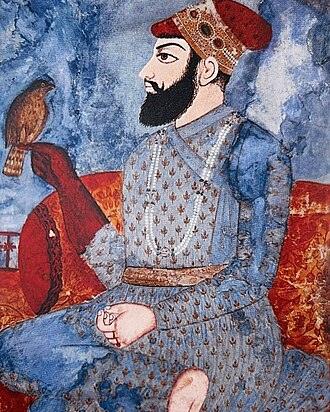
Guru Tegh Bahadur Ji
Ninth Guru of the Sikhs and founder of Anandpur. Beheaded at Chandni Chowk, Delhi, in 1675 after refusing to give up his faith, and remembered as Hind di Chadar.
Guru Tegh Bahadur Ji was the ninth Guru of the Sikhs and the father of Guru Gobind Singh Ji. He was born at Amritsar on 1 April 1621, the youngest of five sons of Guru Hargobind Ji and Mata Nanaki. His birth name was Tyag Mal; he was renamed Tegh Bahadur for his courage. He married Mata Gujri on 4 February 1633.
Becoming Guru. After Guru Hargobind Ji died in 1644 he lived at Bakala with his mother and wife. When Guru Har Krishan Ji, the eighth Guru, indicated that his successor was at Bakala, several men claimed the seat. Makhan Shah Lubana searched among them and found Tegh Bahadur. The Sikh Missionary Society dates his installation to 30 March 1664; the Encyclopaedia of Sikhism, citing the Bhatt Vahi of Talaura, gives 11 August 1664 for his formal anointing.
Anandpur and the journeys. On 19 June 1665 he laid the foundation of Chakk Nanaki, later Anandpur Sahib, on land bought from the hill state of Bilaspur, and named it for his mother. He then travelled east, and his son Gobind Das, the future Guru Gobind Singh Ji, was born at Patna on 22 December 1666.
Key moments
- 25 May 1675: Kashmiri Pandits appeal to him at Anandpur.
- 12 July 1675: arrested; reaches Delhi on 4 November.
- 11 November 1675: beheaded at Chandni Chowk.
1675. On 25 May 1675 a group of Kashmiri Pandits, driven to desperation by the governor Iftikhar Khan, appealed to him at Anandpur. The Encyclopaedia of Sikhism records that when his young son asked why he looked troubled, the Guru answered that the earth would be redeemed only if a worthy person gave his head. He left Anandpur on 11 July 1675 and was arrested the next day at Malikpur Rangharan, according to research based on the Bhatt Vahis; the common belief places the arrest at Agra. He was held for over three months and then taken to Delhi.
In Delhi he was ordered to accept Islam. He refused, and he refused to perform a miracle, saying that no one should interfere with God's Will. On 11 November 1675 Bhai Mati Das was sawn in two and Bhai Sati Das was wrapped in cotton and burned; the Sikh Missionary Society names Bhai Dayala as the third companion martyred before the Guru. The Guru was then beheaded in public at Chandni Chowk, where Gurdwara Sis Ganj Sahib now stands. Lakkhi Shah took the body away and cremated it by setting his own house on fire, on the site of Gurdwara Rikabganj. Bhai Jaita carried the head secretly to Anandpur, where Guru Gobind Singh Ji performed the rites on 16 November 1675.
His bani. His 59 shabads in fifteen ragas and 57 saloks are in Sri Guru Granth Sahib, and the saloks close the Granth. They are in Braj, unlike most of the scripture.
How he is remembered, and how accounts differ. He is called Hind di Chadar. Haryana held a series of events for his 350th Shaheedi Diwas in November 2025, ending with a programme at Jyotisar, Kurukshetra, on 25 November that Prime Minister Narendra Modi attended. A title attributed to the poet Chandra Sain Sainapati of Guru Gobind Singh Ji's court is Srisht di Chadar, protector of humanity. Sikh accounts say he gave his life defending the right of others to follow their faith. Persian chroniclers describe him instead as a bandit or rebel who plundered Punjab; the earliest such account the historian Satish Chandra cites is Ghulam Husain Khan's Siyar-ul-Mutakhkherin, written about 1782, and he warns that it may be an official justification.
Sources
- Tegh Bahadur, Guru (1621-1675), The Encyclopaedia of Sikhism (ed. Harbans Singh), Punjabi University, Patiala. eos.learnpunjabi.org
- Mati Das, Bhai (d. 1675), The Encyclopaedia of Sikhism (ed. Harbans Singh), Punjabi University, Patiala. eos.learnpunjabi.org
- Sati Das, Bhai (d. 1675), The Encyclopaedia of Sikhism (ed. Harbans Singh), Punjabi University, Patiala. eos.learnpunjabi.org
- Lakkhi Shah, The Encyclopaedia of Sikhism (ed. Harbans Singh), Punjabi University, Patiala. eos.learnpunjabi.org
- Anandpur, The Encyclopaedia of Sikhism (ed. Harbans Singh), Punjabi University, Patiala. eos.learnpunjabi.org
- Guru Tegh Bahadur, Sikh Missionary Society (U.K.). sikhmissionarysociety.org
- Haryana holds series of events to mark Guru Tegh Bahadur's martyrdom anniversary, The Tribune. tribuneindia.com
- Guru Tegh Bahadur (Wikipedia, used only for the Persian-source debate and the Srisht di Chadar title), Wikipedia. en.wikipedia.org