Person
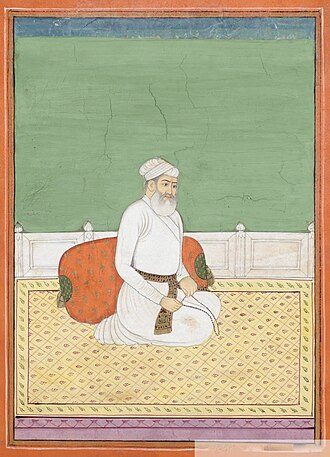
Guru Amar Das Ji
Third Guru of the Sikhs (1552 to 1574): set up the twenty-two manjis, built the baoli at Goindwal, and made every visitor eat in the langar first.
Guru Amar Das, the third Guru, was born into a Bhalla Khatri family on 5 May 1479 at Basarke, a village in present-day Amritsar district. His father was Tej Bhan and his mother Bakht Kaur. He married Mansa Devi and had two sons, Mohri and Mohan, and two daughters, Dani and Bhani. A devout Vaishnava, he made regular pilgrimages to Haridwar, twenty of them according to the chroniclers. On the way back from the twentieth, a sadhu rebuked him for having no guru. In 1540 Bibi Amaro, Guru Angad's daughter and a daughter-in-law of his own family, took him to Guru Angad at Khadur. He became a disciple at once and served the Guru for twelve years, fetching water from the Beas before dawn, working in the langar and gathering firewood.
Guru Angad chose him as his successor and had Baba Buddha apply the tilak. Guru Angad died on 29 March 1552, and Guru Amar Das made Goindwal his headquarters. It lay on the main road between Delhi and Lahore, at the head of an important ferry on the Beas.
What he built
- Twenty-two manjis, preaching districts covering different parts of India. Each was placed under a pious Sikh who spread the Guru's message, looked after the sangat and sent the disciples' offerings to Goindwal.
- The Goindwal baoli, a well with steps down to the water, which became a pilgrim centre. He named the opening days of Baisakh and Magh, and Diwali, as times for Sikhs to gather at Goindwal.
- The langar rule: every visitor was expected to eat in the langar before seeing him, to reduce distinctions of caste and rank. Tradition says Emperor Akbar ate there like any other pilgrim when he visited Goindwal.
- Women: he gave special attention to improving their position, assigned women to supervise communities of disciples in certain areas, and discouraged purdah and sati.
- Simple ceremonies and rites for birth, marriage and death.
- The scripture: he collected the compositions of his predecessors and of some bhaktas into pothis, an important step towards the canon. His own hymns in the Guru Granth Sahib, in seventeen ragas, are in number next only to those of Guru Nanak and Guru Arjan. The best known is the Anandu.
He himself lived on coarse bread earned by his own labour. What came into the kitchen by day was used by night, and nothing was saved for the morrow. A new centre was planned on the site where his successor, Guru Ram Das, later founded Amritsar. The Encyclopaedia of Sikhism notes that one date in his life is firmly known from the Guru Granth Sahib itself: his visit to Kurukshetra at the time of the abhijit nakshatra, which a modern scholar's calculations place on 14 January 1553.
He died on 1 September 1574, having chosen his son-in-law Bhai Jetha as his successor. Bhai Jetha became Guru Ram Das.
Sources
- AMAR DAS, GURU (1479-1574), The Encyclopaedia of Sikhism (Punjabi University, Patiala). eos.learnpunjabi.org
- BHAGAT (BHAKTA) BANI, The Encyclopaedia of Sikhism (Punjabi University, Patiala). eos.learnpunjabi.org