Person
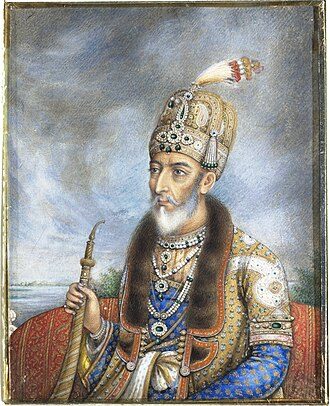
Bahadur Shah Zafar
Last Mughal emperor, a poet and pensioner of the Company who lent his name to the rising of 1857 and died an exile at Rangoon in 1862.
Bahadur Shah II, who wrote verse under the pen name Zafar, was the last Mughal emperor. Born at Delhi on 24 October 1775, he came to the throne in 1837 as a titular emperor paid a pension by the East India Company, with little authority beyond Delhi. In 1857 rebel sepoys came to his court and he gave the rising public support, though accounts describe him as hesitant. The British deposed and tried him and sent him to Rangoon, where he died on 7 November 1862. Do not confuse him with Bahadur Shah I, who succeeded Aurangzeb, or with the Zafarnamah, Guru Gobind Singh's 1706 letter to Aurangzeb, which shares only the word zafar, meaning victory.
Key moments
- 28 September 1837: succeeds his father Akbar II, and is crowned the next day.
- May 1857: sepoy regiments reach his court at Delhi and he lends the rebellion his name.
- 20 September 1857: Major William Hodson captures him at Humayun's Tomb, with a guarantee of his life. The next day Hodson shoots two of his sons and a grandson.
- 27 January to 9 March 1858: tried in the Red Fort by a military commission on charges of rebellion, treason and murder, and found guilty. Because of Hodson's guarantee he is sentenced to transportation for life, not death.
- 7 October 1858: leaves Delhi by bullock cart for Rangoon, with his wives, two remaining sons and servants.
- 7 November 1862: dies at Rangoon aged 87.
The Punjab side of 1857
Punjab had been annexed only eight years earlier. K.C. Yadav, writing in The Tribune in 2007, says the Sikh chiefs of Patiala, Nabha and Jind were loyal to the British, but argues that Sikh soldiers and ordinary Sikhs were not: he writes that about 2,500 Sikhs went to Delhi on their own to fight the British, and that even the Emperor praised their valour. That is his argument, set against the older picture of Sikh loyalty.
He is remembered as the end of the Mughal line. The dynasty had put Guru Arjan Dev Ji to Shaheedi under Jahangir and ordered the arrest and execution of Guru Tegh Bahadur Ji under Aurangzeb, according to the Encyclopaedia of Sikhism. It ended with a defeated old man tried by a colonial power that had already annexed Punjab.
Sources
- Bahadur Shah Zafar, Wikipedia (used because no better source loaded). en.wikipedia.org
- The trial of Bahadur Shah Zafar (Azizul Jalil, Star Weekend Magazine, 1 Feb 2008), The Daily Star (Bangladesh). thedailystar.net
- Profiles of courage: Sikhs were not loyal to the British in 1857 (K.C. Yadav), The Tribune. tribuneindia.com
- Zafarnamah, The Encyclopaedia of Sikhism (ed. Harbans Singh), Punjabi University, Patiala. eos.learnpunjabi.org
- Arjan Dev, Guru (1563-1606), The Encyclopaedia of Sikhism (ed. Harbans Singh), Punjabi University, Patiala. eos.learnpunjabi.org
- Tegh Bahadur, Guru (1621-1675), The Encyclopaedia of Sikhism (ed. Harbans Singh), Punjabi University, Patiala. eos.learnpunjabi.org