Person
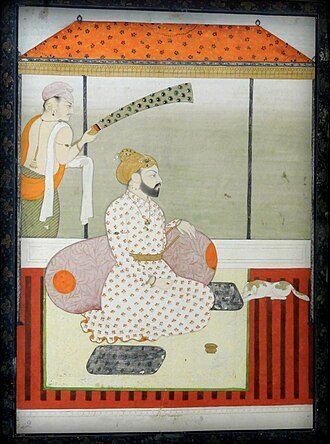
Guru Angad Dev Ji
The second Guru (1539 to 1552), named successor by Guru Nanak over his own sons, who made Khadur the Sikh centre, extended the langar, shaped Gurmukhi and left 63 saloks in the Guru Granth Sahib.
Guru Angad Dev, the second Guru, was born Lahina on 31 March 1504. His father, Bhai Pheru, was a Trehan Khatri trader of modest means whose ancestral home was near Matte di Sarai, now Sarai Nanga, about 16 km from Muktsar. In January 1520 Lahina married Khivi, daughter of Devi Chand of Sanghar, near Khadur. They had two sons, Dasu and Datu, and a daughter, Amaro. Some writers add a second daughter, Anokhi.
The Encyclopaedia of Sikhism says Lahina became a disciple of Guru Nanak in his late twenties, and gives two accounts of how. In one he was the pujari of the Durga shrine at Khadur and was moved on hearing a Sikh sing Guru Nanak's hymn. In the other he met the Guru at Kartarpur while leading a party of pilgrims to a Durga shrine. Guru Nanak named him Angad, meaning limb, because the disciple had become as much a part of him as his own limbs. The janam sakhis stress his patient, unquestioning obedience. Bypassing his own sons, Guru Nanak named him successor on 13 June 1539, and the installation took place a few days before Guru Nanak's death in September 1539.
What he did
- Khadur: he moved there, and it became the centre of the Sikh faith as Kartarpur had been. His day began before dawn with meditation, then Asa di Var, then tending the sick, who came from far, then preaching on Guru Nanak's hymns. At mealtime all sat together without distinction of caste or creed. He earned his own meal by twisting munj reed fibre into string.
- Gurmukhi: the afternoon was for children, and he taught them the Gurmukhi letters himself. The Encyclopaedia says the letters existed before him, and before Guru Nanak, but the origin of Gurmukhi as a script is attributed to Guru Angad, who modified and rearranged certain letters and gave one letter to each Punjabi sound.
- Langar: he extended it. His wife, Mata Khivi, looked after pilgrims and visitors so closely that the langar was known by her name, and the bard Balvand praises her in the Guru Granth Sahib.
- Mall Akhara at Khadur marks the spot where he gave instruction in wrestling.
- Bani: the Guru Granth Sahib holds 63 of his saloks, the smallest collection of the first five Gurus. They stress the Divine Will, the Name, and the grace of the Guru.
He died at Khadur on 29 March 1552 and passed the succession to Guru Amar Das, who had served him for twelve years.
What he is remembered for: holding the Panth together in the years after Guru Nanak, with Khadur as its seat; the Gurmukhi script in which the Gurus' word is written; and his obedience to Guru Nanak, which the Encyclopaedia says is why he was chosen to lead.
Sources
- Angad Dev, Guru (1504-1552), The Encyclopaedia of Sikhism (ed. Harbans Singh), Punjabi University, Patiala. eos.learnpunjabi.org
- Gurmukhi, The Encyclopaedia of Sikhism (ed. Harbans Singh), Punjabi University, Patiala. eos.learnpunjabi.org
- Guru ka Langar, The Encyclopaedia of Sikhism (ed. Harbans Singh), Punjabi University, Patiala. eos.learnpunjabi.org
- Khadur Sahib, The Encyclopaedia of Sikhism (ed. Harbans Singh), Punjabi University, Patiala. eos.learnpunjabi.org
- Amar Das, Guru (1479-1574), The Encyclopaedia of Sikhism (ed. Harbans Singh), Punjabi University, Patiala. eos.learnpunjabi.org