Person
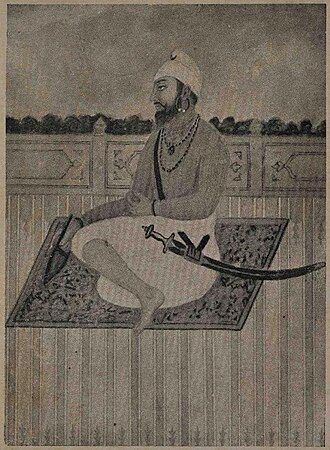
Bhai Santokh Singh
Early nineteenth-century Nirmala poet and historian, author of the 51,820-verse Sri Gur Pratap Suraj Granth on the lives of the Gurus. Widely read in katha, and questioned by modern historians.
Bhai Santokh Singh was a Sikh poet and scholar, and the author of the Sri Gur Pratap Suraj Granth, also called Suraj Prakash, the long Braj poem on the lives of the Gurus. The Encyclopaedia of Sikhism says he was born on 8 October 1787 at Sarai Nurdin, near Tarn Taran, to Bhai Deva Singh and Mai Rajadi, who were cloth-printers. His father was poor but learned in the sacred texts. SearchGurbani calls him a Nirmala scholar.
Key moments
- He studied for about fifteen years at Amritsar under Giani Sant Singh (1768 to 1832), taking in Sikh scripture and history, Sanskrit, poetics, philosophy and mythology.
- Before 1813 he settled at Buriya, in present-day Haryana, under the patronage of Diwan Singh, who served Sardar Hari Singh, the chief of Buriya.
- His works: Nam Kosh (1821), a Hindi verse translation of the Amar Kosha; Sri Gur Nanak Prakash (1823), an epic of 9,700 verses on Guru Nanak Dev Ji; Garab Ganjani Tika (1829), a Hindi prose commentary on Guru Nanak's Japu; a Braj verse translation of the Valmiki Ramayana (1834); and a prose translation of the Atma Purana.
- 1825: Bhai Udai Singh, the chief of Kaithal, invites him to his court. He stays at Kaithal for eighteen years.
- 1835 to 1843: he writes the Sri Gur Pratap Suraj Granth, of 51,820 verses. He died at Kaithal on 19 October 1843, soon after finishing it. A shrine in his memory was built at Sarai Nurdin in the 1950s.
The Suraj Prakash. SearchGurbani describes it in two parts: the Sri Gur Nanak Prakash on Guru Nanak Dev Ji, and the Sri Gur Pratap Suraj on the nine Gurus who followed and on Banda Singh Bahadur. It is written in Braj Bhasha in the Gurmukhi script. The page calls it a voluminous classical source and the most valuable source book for the Guru period, though it notes that scholars trained in modern historiography point out drawbacks. It says gianis give regular discourses on it in gurdwaras. Bhai Vir Singh brought out an annotated edition between 1927 and 1935.
The argument over it. Wikipedia lists the scholars who have questioned it. Max Arthur Macauliffe (1909) doubted its trustworthiness and said its author's education and heritage were "largely tinctured with Hinduism". W. H. McLeod, around 1968, questioned its historical value because of its mythology. Ganda Singh criticised Santokh Singh for accepting Sikh texts such as the Mehma Prakash and the Sau Sakhi without question. Anne Murphy wrote in 2012 that historians seldom use it, probably because of its Hinduised reputation, which she thought somewhat unfair. In defence, Vir Singh argued that its mythology and references to the Puranas serve as metaphors for the Gurus' deeds and powers, and that miracle stories open the heart in ways scientific history cannot.
What he is remembered for: a vast Braj poem that gianis still draw on in gurdwara discourses, and that remains at the centre of the argument over how far the lives of the Gurus can be read as history. The Encyclopaedia of Sikhism gives no critical verdict of its own, and calls him a poet and historian.
Sources
- Santokh Singh, Bhai (1787-1843), The Encyclopaedia of Sikhism (ed. Harbans Singh), Punjabi University, Patiala. eos.learnpunjabi.org
- Sri Gur Pratap Suraj Granth, SearchGurbani. searchgurbani.com
- Suraj Prakash, Wikipedia (used only for the scholars' criticism and defence of the work). en.wikipedia.org