Person
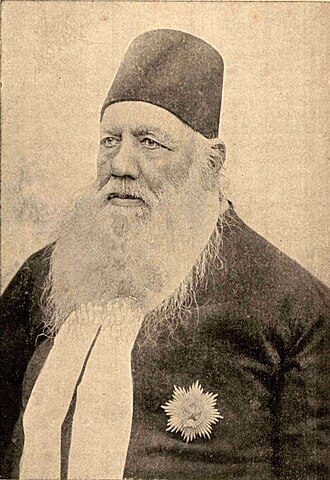
Sir Sayyid Ahmad Khan
Muslim reformer and founder of the Aligarh college whose 1888 Meerut speech on Hindus and Muslims as two communities made him a founding name in the politics that led to Partition.
Sir Sayyid Ahmad Khan (1817 to 1898) was a Muslim reformer, writer and British civil servant who founded the Muhammadan Anglo-Oriental College at Aligarh. He appears in this record because of what he argued about Hindus, Muslims and political representation. Encyclopedia.com says his political separatism later inspired the movement for a separate Pakistan, and the Partition of 1947 divided Punjab. How far that was his intention is a separate question, taken up below.
Key moments
- He was born in Delhi on 17 October 1817 and died at Aligarh on 27 March 1898 (Wikipedia). He joined the British subordinate judicial service and wrote on history and religion and was an early pioneer of printed Urdu prose (Encyclopedia.com).
- 1857: he stayed loyal to the British during the revolt. Wikipedia says he sheltered British officers and their families at Bijnor and lost relatives in the violence.
- 1864 to 1875: he founds the Scientific Society at Ghazipur in 1864, to translate practical and scientific works into Urdu (Encyclopedia.com). Encyclopedia.com says it moved to Aligarh in 1865. Wikipedia's article on the Society dates its founding to 1862 and its move to April 1864. After a trip to England in 1869 he plans a residential college, and the Muhammadan Anglo-Oriental College opens at Aligarh in 1875 (Encyclopedia.com). It became Aligarh Muslim University in 1920 (Wikipedia).
- January 1884: at Gurdaspur, in Punjab, Wikipedia says he described the Hindus, Muslims and Christians of the country as one nation.
- 1886 to 1887: he founds the Muhammadan Educational Conference (Wikipedia) and opposes the Indian National Congress, arguing that representative government was not in the best interests of Muslims. The British knight him in 1888 (Encyclopedia.com).
- March 1888: in a speech at Meerut, in the Pioneer's English translation, he asks whether two nations, the Mahomedans and the Hindus, could sit on the same throne and remain equal in power, and says "it is necessary that one of them should conquer the other and thrust it down". The page that carries the translation notes that the Urdu word is qaum, which can mean community or people.
Critics and assessments: Wikipedia lists Lala Lajpat Rai among his critics. It says he is widely credited as the father of the two-nation theory and presents the Urdu and Hindi controversy as the turning point in his thinking.
Remembered for: pressing modern English and scientific education on Muslim families through Aligarh, and for an argument about separate Muslim political interests that Encyclopedia.com says later inspired the demand for Pakistan.
Sources
- Ahmad Khan, (Sir) Sayyid (1817-1898), David Lelyveld, Encyclopedia of Islam and the Muslim World, Encyclopedia.com (Gale). encyclopedia.com
- Sir Syed Ahmed on the Present State of Indian Politics, Meerut speech of March 1888 (Pioneer Press translation, 1888), text at Columbia University, Francis W. Pritchett. franpritchett.com
- Syed Ahmad Khan (dates, 1857, Gurdaspur speech, critics, historians' label), Wikipedia. en.wikipedia.org
- Scientific Society of Aligarh (founded at Ghazipur 9 January 1862, moved to Aligarh April 1864 on its account), Wikipedia. en.wikipedia.org