Person
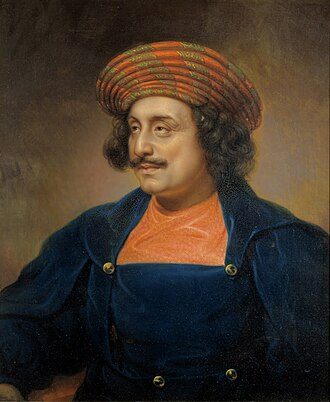
Raja Rammohun Roy
Bengali scholar and reformer who founded the Brahmo Sabha in 1828 and campaigned against sati; his reform movement later reached Punjab, where Sardar Dyal Singh Majithia joined it.
Raja Rammohun Roy (1772 to 1833) was a Bengali scholar, journalist and religious reformer, often called the father of the Bengal Renaissance. He never worked in Punjab. He belongs in this record because the reform movement he started reached Punjab a generation after his death.
He was born on about 22 May 1772 at Radhanagar in Bengal, into a Brahmin family. By fifteen he knew Bengali, Persian, Arabic and Sanskrit. His reading of the Upanishads convinced him that Hinduism taught one Absolute Reality, and he spoke and wrote against idol worship, caste rigidity, polygamy and child marriage. He published an ethical reading of the teachings of Jesus, The Precepts of Jesus, without accepting Jesus as divine, and edited the Bengali journal Samvad Kaumudi, which argued for press freedom and for separating executive and judicial power.
Key moments
- 1828: he founded the Brahmo Sabha at Calcutta for monotheism and social reform. It became the Brahmo Samaj.
- 1829: the Governor-General, Lord William Bentinck, made sati illegal in Bengal. Roy had campaigned against the practice.
- 1830 or 1831: the sources differ on the year. He travelled to England as an envoy of the Mughal emperor, to see that the ban on sati was not overturned.
- 27 September 1833: he died at Stapleton, near Bristol. His tomb stands at Arnos Vale cemetery in Bristol.
The Punjab link: according to Wikipedia, the first Brahmo Samaj branch in Punjab was founded at Lahore in 1861, and others followed at Quetta, Rawalpindi and Amritsar. Sardar Dyal Singh Majithia (1848 to 1898), of the Majithia family that had served Maharaja Ranjit Singh, was a founding member of the Sadharan Brahmo Samaj, and in 1881 he founded The Tribune at Lahore, as the Tribune itself records.
What he is remembered for: the campaign against sati and the founding of the Brahmo movement.
Sources
- Ram Mohan Roy, New World Encyclopedia. newworldencyclopedia.org
- Ram Mohan Roy (used for his family and the Mughal title, where no better source loaded), Wikipedia. en.wikipedia.org
- Rammohun Roy in Bristol, The Bristol Cable. thebristolcable.org
- Brahmo Samaj (used for the Lahore branch of 1861, where no better source loaded), Wikipedia. en.wikipedia.org
- Dyal Singh Majithia (used for the Sadharan Brahmo Samaj membership, where no better source loaded), Wikipedia. en.wikipedia.org
- Dyal Singh Majithia and his legacy (2017), The Tribune. tribuneindia.com