Person
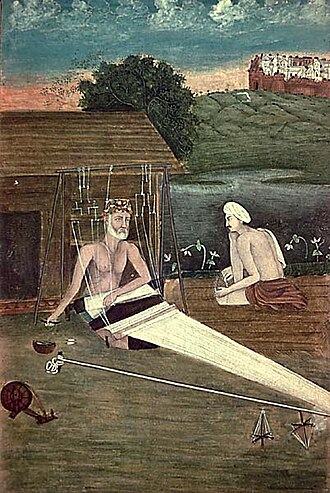
Bhagat Kabir
Fifteenth-century weaver-poet of Kashi whose 227 padas and 237 slokas in the Guru Granth Sahib are the largest share of any Bhagat.
Bhagat Kabir was a poet and saint of Kashi (Banaras) in the fifteenth century. The Encyclopaedia of Sikhism calls him one of the great names in the literary and religious history of North India. Little reliable information about his life survives, though legend gathers thickly around him. His followers, the Kabirpanthis, hold that he lived 120 years, from 1398 to 1518. Recent scholarship accepts 1398 as the year of his birth but 1448 as the year of his death.
He belonged to the julaha (weaver) caste and, as his own verse shows, followed the weaver's trade. Tradition says a Muslim weaver named Niru adopted him. Scholars think his family may have been non-celibate Nath yogis who had lately, and only on the surface, turned to Islam. In Kashi, the stronghold of Brahmanical orthodoxy, he condemned idol worship, ritual bathing, pilgrimage and fasting, and he acknowledged no caste distinctions. He rebelled against the pretension that books or authority could settle the mystery of the human condition and the question of liberation. This drew the anger of both Hindus and Muslims around Banaras, and tradition has him spend his last days not in Banaras but in the village of Maghar.
How his verse reached the Sikh scripture
- His hymns appear in the Goindwal pothis, anthologies of the Gurus' hymns and those of some bhaktas prepared in the time of Guru Amar Das.
- In 1604 Guru Arjan compiled the Adi Granth and entered Kabir's verse in it.
- In the Guru Granth Sahib he has 227 padas in 17 ragas and 237 slokas, the largest contribution of any Bhagat. Under each raga his hymns stand at the head of the Bhagat Bani section.
Kabir taught belief in one Supreme Being, beyond the world and within the soul, reached by the path of loving devotion. He used the name Ram often, but the Encyclopaedia stresses that he did not mean Rama, the son of Dasaratha. In two of his slokas in the Guru Granth Sahib he separates Rama, the king of Ayodhya, from Ram as God.
The Encyclopaedia also takes up a claim made by some Western scholars, that Kabir was the forerunner or even the teacher of Guru Nanak. It finds no evidence that the two ever met, notes that their lifetimes do not overlap, and sees little to suggest that Guru Nanak owed anything to Kabir's teaching.
Sources
- KABIR, The Encyclopaedia of Sikhism (Punjabi University, Patiala). eos.learnpunjabi.org
- BHAGAT (BHAKTA) BANI, The Encyclopaedia of Sikhism (Punjabi University, Patiala). eos.learnpunjabi.org