Person
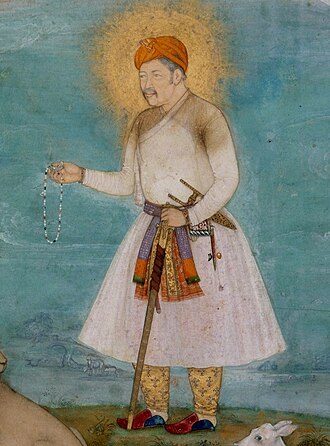
Akbar
Third Mughal emperor (1556 to 1605). Sikh tradition remembers his langar meal at Goindwal with Guru Amar Das and his dealings with Guru Arjan Dev, before the harder reign of Jahangir.
Akbar was the third Mughal emperor. He was born on 15 October 1542, came to the throne in February 1556 at Kalanaur in the Punjab, aged 14, and died on 27 October 1605 at Fatehpur Sikri. He spent about thirteen years in the north, with Lahore as his capital from 1585 until he returned the capital to Agra in 1599 (Wikipedia).
Wikipedia notes that Muslim rulers in India, with the exception of Akbar, collected jizya from Hindus, Buddhists, Jains and Sikhs. In 1575 he built the Ibadat Khana at Fatehpur Sikri for debates among scholars of different faiths, an approach linked to the policy of sulh-i-kul, peace with all. For the Panth he is the emperor of the years in which the third, fourth and fifth Gurus built up Goindwal and the town and tank that became Amritsar.
Akbar and the Gurus
- Goindwal and Guru Amar Das: the Encyclopaedia of Sikhism says the Guru expected every visitor to eat in the langar before seeing him, and that Akbar, who once visited him at Goindwal, is said to have eaten there like any other pilgrim. It gives no date. Wikipedia places the meeting in 1567 in one article and 1569 in another, and, citing Cole and Sambhi, says the Guru persuaded Akbar to repeal the tax on Hindu pilgrims going to Haridwar.
- The land of Amritsar: accounts differ. The Encyclopaedia says the site of the tank was, according to some sources, bought in Guru Amar Das's time and, according to others, a gift from Akbar to the Guru's daughter Bibi Bhani, wife of Guru Ram Das. Wikipedia's Goindwal article says Akbar granted land in her name after the langar meal. Another telling, the Gurbilas Patshahi 6 as cited by Wikipedia, has him offer 84 villages after Guru Amar Das himself refused.
- November 1598: Akbar visited Guru Arjan Dev at Goindwal and asked for spiritual guidance (Encyclopaedia of Sikhism). Wikipedia, citing Grewal, says Abu'l Fazl's Akbarnama records the emperor stopping at the Guru's house on crossing the Beas on his way from Lahore.
- The Encyclopaedia adds that at the Guru's instance the emperor remitted 10 to 12 per cent of the land revenue in the Punjab. When complaints reached Akbar that the Granth was derogatory to Islam, he asked to see Guru Arjan from his camp at Batala. The Guru sent Bhai Budha and Bhai Gurdas with the Granth, it was read at the spot Akbar pointed out, and he, pleased, offered 51 gold mohars and robes of honour.
The Encyclopaedia contrasts him with his son Jahangir, who succeeded him in 1605 and was less liberal and tolerant; the Sikhs were the first to bear the brunt of his malice. Guru Arjan Dev was martyred in 1606.
Akbar is remembered in Sikh memory as the ruler who sat with the sangat in the langar and respected the Gurus, the standard against which the later persecution is measured.
Sources
- Amar Das, Guru (1479-1574), Encyclopaedia of Sikhism, Punjabi University. eos.learnpunjabi.org
- Arjan Dev, Guru (1563-1606), Encyclopaedia of Sikhism, Punjabi University. eos.learnpunjabi.org
- Harimandar, Encyclopaedia of Sikhism, Punjabi University. eos.learnpunjabi.org
- Akbar (dates, capital, Ibadat Khana), Wikipedia. en.wikipedia.org
- Goindwal (Akbar's visits, Akbarnama), Wikipedia. en.wikipedia.org
- Guru Amar Das (Akbar's visit, pilgrim tax, Gurbilas Patshahi 6), Wikipedia. en.wikipedia.org
- Jizya, Wikipedia. en.wikipedia.org