Person
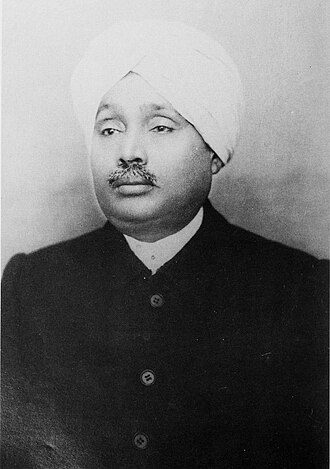
Lala Lajpat Rai
Lahore lawyer, Arya Samaj leader and Congress figure known as Punjab Kesari; president of the Hindu Mahasabha session of 1925; died in 1928 after a police lathi charge in Lahore.
Lala Lajpat Rai (1865 to 1928) was a Punjabi lawyer, Arya Samaj leader and nationalist, known as Punjab Kesari, the Lion of Punjab. For this history he matters because he belonged to the Arya Samaj in Lahore, the movement that, in Wikipedia's account, the Sikh-dominated Singh Sabha opposed, and because of his later place in Hindu Mahasabha and Congress politics.
He was born on 28 January 1865 at Dhudike, in what is now Moga district. He studied law at Government College, Lahore, where Swami Dayanand's reform movement drew him in, and he joined the Arya Samaj in December 1882. He edited the Arya Gazette, wrote for The Tribune and was associated with the early management of the Punjab National Bank.
Key moments
- 1907: after political agitation in Punjab, the British sent him to Mandalay in Burma.
- 1914 to 1920: abroad in Britain and the United States. In 1916 he toured Sikh communities along the American Western Seaboard. In 1920 he presided over the Congress special session at Calcutta. In 1921 he founded the Servants of the People Society in Lahore.
- 14 December 1924: a Tribune article of his, one of a series called "The Hindu-Muslim Problem", proposed dividing India into Muslim and non-Muslim parts and caused wide controversy.
- April 1925: he presided over the eighth annual session of the All-India Hindu Mahasabha at Calcutta. Madan Mohan Malaviya had founded the Mahasabha in 1915.
- 30 October 1928: he led a march against the Simon Commission in Lahore. The police superintendent, James Scott, ordered a lathi charge and Rai was struck. He died on 17 November 1928. Doctors believed the blows hastened his death, and the British government denied any role.
- 17 December 1928: Bhagat Singh and Rajguru shot John Saunders, an assistant superintendent of Lahore Police, in a case of mistaken identity, to avenge Rai.
Remembered for: leading Punjab's nationalist politics before 1928, and his death at the Simon Commission protest. ThePrint noted in 2024 that although he spoke for Hindu rights, he said a Hindu Raj would ruin Hinduism as well as India.
Sources
- Lala Lajpat Rai (birth, Arya Samaj, 1907 Mandalay, 1916 tour of Sikh communities, Simon Commission march and death), Wikipedia. en.wikipedia.org
- Lala Lajpat Rai: A freedom fighter and proud son of the soil, ThePrint. theprint.in
- The Hindu Mahasabha and the Indian National Congress, 1915 to 1926 (Richard Gordon, Modern Asian Studies 9:2, 1975; footnotes 139 and 202), Cambridge University Press. cambridge.org
- Lala Lajpat Rai was no Savarkar. He said Hindu Raj 'would ruin India' (10 Apr 2024), ThePrint. theprint.in
- Arya Samaj (opposition to it by the Singh Sabha in Punjab; used because no better source gave it), Wikipedia. en.wikipedia.org
- Hindu Mahasabha (founding in 1915 under Madan Mohan Malaviya), Wikipedia. en.wikipedia.org
- Ham Hindu Nahin, Encyclopaedia of Sikhism, Punjabi University, Patiala. eos.learnpunjabi.org
- Ham Hindu Nahin: Arya-Sikh Relations, 1877-1905 (Kenneth W. Jones, Journal of Asian Studies 32:3, 1973), Cambridge University Press. cambridge.org
- Politics, partition, and poetry (by Mahmood Awan, 23 Jul 2017; gives his Tribune article of 14 December 1924, citing K. K. Aziz), The News on Sunday (Pakistan). thenews.com.pk
- The Hindu-Muslim Problem (1924), Part 11: Lala Lajpat Rai's text, "a clear partition of India into a Muslim India and a non-Muslim India", Frances Pritchett, Columbia University. franpritchett.com