Person
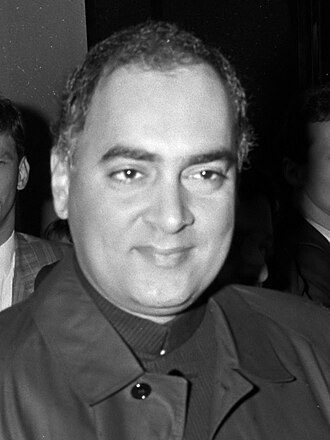
Rajiv Gandhi
Prime Minister from 31 October 1984, sworn in the day Indira Gandhi was killed; remembered by Sikhs for the 'big tree' speech after the Tesra Ghallughara and for the 1985 Rajiv-Longowal Accord.
Rajiv Gandhi was born in Mumbai on 20 August 1944 and was Prime Minister of India from 31 October 1984 to 1989. He was sworn in on the day his mother, Indira Gandhi, was assassinated. In this history he is the Prime Minister under whom the Tesra Ghallughara began, who signed the Rajiv-Longowal Accord, and whose government put Punjab under central rule in 1987. The Tribune records that Congress won 404 seats in 1984 and fell to 197 in 1989.
Key moments
- 31 October 1984: sworn in as Prime Minister. For three days mobs attacked Sikhs in Delhi and other cities. The Ahuja Committee put the Delhi toll at 2,733 Sikhs killed. Human Rights Watch reports that investigations found the violence was led or often carried out by Congress activists and sympathisers, and that police stood by or took part.
- November 1984: at a rally on Indira Gandhi's birth anniversary he said, in Human Rights Watch's rendering, "Once a mighty tree falls, it is only natural that the earth around it shakes." Scroll writes that it is remembered as his justification of the killings.
- 24 July 1985: signs the Rajiv-Longowal Accord with Sant Harchand Singh Longowal. Longowal was shot dead on 20 August 1985. The Tribune says many of the accord's terms, among them the transfer of Chandigarh, were never implemented.
- 11 May 1987: Punjab goes under President's rule, which lasted until 25 February 1992 (Human Rights Watch).
- 21 May 1991: killed by a human bomb of the LTTE at Sriperumbudur, Tamil Nadu. He received the Bharat Ratna posthumously in 1991 (Scroll).
The question of his responsibility: The Nanavati Commission, whose report reached Parliament in August 2005, found no evidence that Rajiv Gandhi or any other high-ranking leader "suggested or organised" the attacks, in which nearly 3,000 people were killed (The Tribune). Prime Minister Manmohan Singh, who apologised for 1984 in 2005, said the report found "no evidence, whatsoever, against the top leadership of the Congress Party" (Human Rights Watch). The commission named local Congress leaders, and said Jagdish Tytler very probably had a hand in organising attacks; Human Rights Watch notes that Tytler later became a minister under Rajiv Gandhi.
Sikh lawyers and campaigners point to his speech. In November 2015 HS Phoolka and the BJP's RP Singh released video of it and asked for the Bharat Ratna to be withdrawn (Scroll). On 21 December 2018 the Delhi Assembly adopted a resolution calling the 1984 violence genocide. A proposal from an AAP member to withdraw the Bharat Ratna was never put to the vote, and AAP leaders said it was not part of the resolution. Congress leader Ajay Maken said Rajiv Gandhi "sacrificed his life for the country" (Scroll).
Remembered for: for Sikhs, the speech, the unfulfilled accord and the years of central rule. For Congress, a former Prime Minister assassinated in 1991 who, it says, gave his life for the country.
Sources
- Decade that shaped Rajiv Gandhi's destiny, The Tribune. tribuneindia.com
- India: No Justice for 1984 Anti-Sikh Bloodshed (29 Oct 2014), Human Rights Watch (mirrored on ecoi.net). ecoi.net
- Watch Rajiv Gandhi make his infamous 'big tree falls' speech (20 Nov 2015), Scroll.in. scroll.in
- 25 years after Rajiv-Longowal Accord (Aug 2010), The Tribune. tribuneindia.com
- A moderate, signed Rajiv-Longowal accord (20 Aug 2024), The Tribune. tribuneindia.com
- Protecting the Killers: A Policy of Impunity in Punjab, India (2007), Human Rights Watch. hrw.org
- Nanavati report and Action Taken Report tabled (9 Aug 2005), The Tribune. tribuneindia.com
- 1984 anti-Sikh violence: Delhi Assembly wants Rajiv Gandhi's Bharat Ratna to be withdrawn (21 Dec 2018), Scroll.in. scroll.in
- AAP's Rajiv Gandhi resolution may have jeopardised possible alliance with Congress in 2019, Scroll.in. scroll.in
- Why and how LTTE assassinated Rajiv Gandhi, News Arena India. newsarenaindia.com