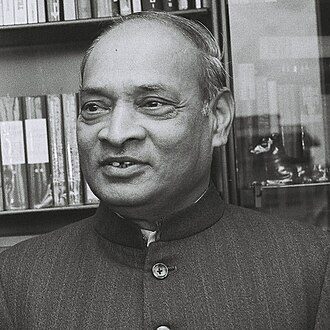
PV Narasimha Rao
ਪੀ.ਵੀ. ਨਰਸਿਮਹਾ ਰਾਓ
Union Home Minister during the November 1984 pogrom and Prime Minister from 1991 to 1996. The Nanavati Commission found no delay or indifference by him; witnesses and critics disagree.
PV Narasimha Rao was a Congress leader who was Union Home Minister from 19 July to 31 December 1984, which covers the days of the November 1984 pogrom, and later Prime Minister of India from 21 June 1991 to 16 May 1996. According to Wikipedia he was born on 28 June 1921 at Laknepalli in the Hyderabad state and died on 23 December 2004.
Key moments
- 31 October 1984: Rao told the Nanavati Commission that he was at Hanamkonda in Andhra Pradesh when Indira Gandhi was shot, that he reached Delhi at about 4.40 pm, and that he then took part in making Rajiv Gandhi Prime Minister.
- 1 to 3 November 1984: witnesses told the commission about their meetings with him. Ram Jethmalani found him listless and unenthusiastic and said no instructions were given in his presence. Kamini Jaiswal said Rao did not react and said he would look into it. Patwant Singh said that on the afternoon of 1 November he went with Lt Gen J. S. Aurora and I. K. Gujral to Rao's house, found no activity there, found the Home Minister impassive, and was told the army would arrive that evening.
- Rao's reply to the commission, the last explanation it received, submitted on 24 November 2004: he denied indifference and said he was in constant touch with the Home Secretary, the Lieutenant Governor and the Police Commissioner, and had given instructions to deploy police and army. He also said the Home Minister was not competent to call troops, which was for the Army Chief under the Defence Ministry.
- 23 December 2004: he dies, about seven weeks before the commission's report.
- 9 February 2005: the commission found no delay or indifference at the level of the Home Minister. It said that prominent people who met him carried an impression that he was not as responsive as the situation demanded, but that this was because of his style of functioning, and that he appeared to have kept himself informed and given instructions in time. The same report held the Lieutenant Governor, P. G. Gavai, and the Police Commissioner, S. C. Tandon, responsible for the failure to keep order.
- December 2019: Manmohan Singh said that I. K. Gujral had gone to Rao that evening and urged that the army be called at once, and that the violence could have been avoided had Rao heeded him. Rao's grandson N. V. Subhash called the remark unacceptable and said calling the army would have been a disaster. H. S. Phoolka praised Singh's remark and said Rajiv Gandhi had not agreed to call the army (The Week).
As Prime Minister. Wikipedia credits Rao with the economic opening of 1991 to 1996, with Manmohan Singh as Finance Minister. It adds that he is said to have been solely responsible for the decision to hold elections in Punjab, however narrow the electorate. In 2000 a special court convicted him in the case over the 1993 no-confidence vote, and the Delhi High Court overturned that conviction in 2002. In a separate cheating case he was acquitted in 2003.
What he is remembered for: the economic reforms of the early 1990s, and, among Sikhs, his place as Home Minister in the first days of November 1984, where the commission's finding and the witnesses' accounts point different ways.
Back to ThreadsSee its threads
Sources
- Justice Nanavati Commission of Inquiry (1984 Anti-Sikh Riots) Report, Volume I (2005), Delhi High Court (copy of the Ministry of Home Affairs report). delhihighcourt.nic.in
- Manmohan's comments on Narasimha Rao, anti-Sikh riots spark controversy (PTI, 5 December 2019), The Week. theweek.in
- P. V. Narasimha Rao, Wikipedia (used for his dates in office and the corruption cases). en.wikipedia.org