Person
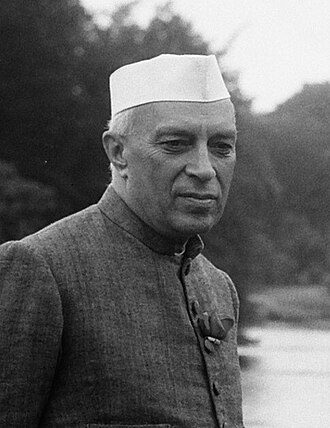
Jawaharlal Nehru
First Prime Minister of India (1947 to 1964), whose 1946 words on a Sikh unit, the 1959 pact with Master Tara Singh and his refusal of a Punjabi-speaking state shaped Akali politics.
Jawaharlal Nehru (14 November 1889 to 27 May 1964) was a leader of the Indian National Congress in the freedom struggle and India's first Prime Minister, from 15 August 1947 until he died in office. For Sikhs he matters as the Congress leader whose statements, pacts and refusals the Akalis weighed for two decades.
Key moments
- December 1929: he presided over the Congress session at Lahore. Sikh leaders had rejected the Nehru Report, drafted by a committee chaired by his father, Motilal Nehru. The Congress dropped it at Lahore and adopted a motion that it would accept no constitutional solution that did not satisfy the Sikhs and Muslims.
- 4 April 1946: in a public statement he said he stood for semi-autonomous units and wanted the Sikhs to have a semi-autonomous unit within the province so that they might "experience the glow of freedom". The Encyclopaedia of Sikhism records that the Akali Dal, which had opposed partition, then cast its lot with the Congress, trusting it to protect the Sikhs' minority rights.
- 2 September 1946: he headed the Interim Government, which Baldev Singh joined as the Sikhs' nominee, taking the defence portfolio.
- 3 June 1947: he, Jinnah and Baldev Singh for the Sikhs consented to Mountbatten's plan to partition the country and Punjab.
- 1955: Master Tara Singh led an Akali delegation to him on 24 October and 23 November over the demand for a Punjabi-speaking state.
- 11 April 1959: after Master Tara Singh threatened a fast, Nehru met him over tea and they agreed the Tara Singh-Nehru Pact. It said there should be no government interference in Sikh religious affairs and that the Sikh Gurdwaras Act would not be amended without the approval of the SGPC's general body. A joint committee set up under it reached no conclusion.
- December 1960 to 1961: when Sant Fateh Singh vowed to fast to death for a Punjabi Suba, Nehru refused to intervene. He told a Chandigarh audience on 20 December 1960 that Punjabi was the dominant language of Punjab and must be promoted. In meetings with Fateh Singh in 1961 he offered protection for the language but would not carve out Punjabi-speaking areas. Master Tara Singh ended his own 48-day fast on 1 October 1961.
A Punjabi-speaking state came into being on 1 November 1966, after his death.
What he is remembered for: in Akali memory, the 1946 words are treated as a promise to the Sikhs that went unkept, and his government's line on Punjabi Suba as a refusal. That is how the Akali side reads it. The sources used here show the 1946 statement as one made in public and do not record a formal pledge. Nehru is otherwise remembered for leading the first government of independent India for 16 years. This page follows only his dealings with the Sikhs.
Sources
- Tara Singh-Nehru Pact, The Encyclopaedia of Sikhism (ed. Harbans Singh), Punjabi University, Patiala. eos.learnpunjabi.org
- Punjabi Suba Movement, The Encyclopaedia of Sikhism (ed. Harbans Singh), Punjabi University, Patiala. eos.learnpunjabi.org
- Central Sikh League, The Encyclopaedia of Sikhism (ed. Harbans Singh), Punjabi University, Patiala. eos.learnpunjabi.org
- Baldev Singh (1902-1961), The Encyclopaedia of Sikhism (ed. Harbans Singh), Punjabi University, Patiala. eos.learnpunjabi.org
- Partition of the Punjab (1947), The Encyclopaedia of Sikhism (ed. Harbans Singh), Punjabi University, Patiala. eos.learnpunjabi.org
- Akali Dal, Shiromani (vol. 1, pp. 46-48, entry by Major Gurmukh Singh), The Encyclopaedia of Sikhism (ed. Harbans Singh), Punjabi University, Patiala. archive.org
- Jawaharlal Nehru (for his dates), Wikipedia. en.wikipedia.org