Person
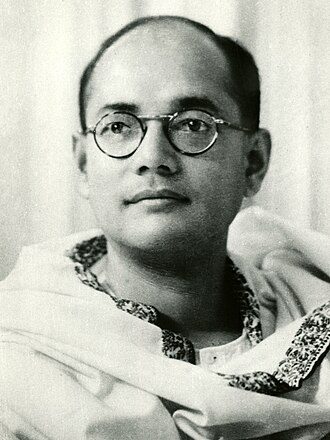
Subhas Chandra Bose
Bengali Congress leader who led the Provisional Government of Free India and the INA. Sikhs were a large share of the first INA, and a Sikh officer stood trial at the Red Fort in 1945.
Subhas Chandra Bose, called Netaji, was born at Cuttack on 23 January 1897. He placed fourth in the Indian Civil Service examination in 1920 and in April 1921 asked to be struck off the list of probationers. He was elected president of the Indian National Congress in 1938 and re-elected in 1939, then resigned in April 1939 after disputes with Gandhi and the Congress leadership and organised the All India Forward Bloc in 1939 (Wikipedia gives 22 June).
Key moments
- January 1941: he leaves Calcutta in secret and, by way of Afghanistan and the Soviet Union, reaches Berlin, where he sets up a Free India Centre.
- December 1941 to September 1942: Captain Mohan Singh takes charge of Indian prisoners at Alor Star. The Indian National Army (INA) is formally set up on 1 September 1942 with about 40,000 volunteers, and the Encyclopaedia of Sikhism says a large number of the men who came forward were mostly Sikhs. On 29 December 1942 the Japanese remove Mohan Singh from command and detain him.
- 1943: Bose travels by submarine to Japanese-held South-East Asia, takes over the INA at Singapore in July (Wikipedia; Banglapedia gives 25 August 1943 for his becoming its Commander-in-Chief), and on 21 October 1943 declares the Provisional Government of Azad Hind (Free India) (Banglapedia). The INA fights alongside the Japanese in the 1944 offensive towards Imphal and Kohima, which fails.
- 18 August 1945: according to the generally accepted account, he dies at Taihoku (Taipei) from burns after a plane crash. Many of his supporters, especially in Bengal, have refused to accept it.
- 5 November 1945: the first INA trial opens at the Red Fort. The three officers tried together are Shah Nawaz Khan, Prem Sahgal and Gurbaksh Singh Dhillon, a Muslim, a Hindu and a Sikh. They are found guilty on 31 December and sentenced to deportation for life. After nationwide protest they are freed on 3 January 1946 (Open, Scroll).
Scroll reports that the British court-martialled about 600 of roughly 22,000 INA members. Its author argues that the trials showed the British had effectively lost the Indian Army they needed to hold India. Wikipedia notes that the INA's professional soldiers were mostly Punjabis, who faced an uncertain future after the war.
What he is remembered for. Bose is remembered for taking up armed struggle against British rule in alliance with the Axis powers, and for an army raised first from prisoners of war that drew Sikhs and other Punjabis in numbers. For the Panth the main points are the Sikh soldiers who joined the first INA, the Sikh officer tried at the Red Fort, and the nationwide protest that followed the trials in the last years before Partition.
Sources
- Bose, Subhas Chandra, Banglapedia. en.banglapedia.org
- Mohan Singh, General (1909-1989), The Encyclopaedia of Sikhism (ed. Harbans Singh), Punjabi University, Patiala. eos.learnpunjabi.org
- The 'INA Three' trial the Raj lost (Ullekh NP), Open Magazine. openthemagazine.com
- The Red Fort trial of the INA, release of the three on 3 January 1946 (Gautam Hazarika, 3 January 2026), Scroll.in. scroll.in
- Subhas Chandra Bose (Congress presidency, escape, death; used only where nothing better loaded), Wikipedia. en.wikipedia.org