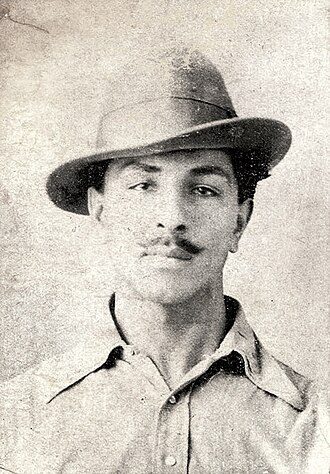
Shaheed Bhagat Singh
ਸ਼ਹੀਦ ਭਗਤ ਸਿੰਘ
Revolutionary born into a Sikh family in Lyallpur, hanged at Lahore on 23 March 1931 aged 23. Remembered as Shahidi Azam, and for his 116-day jail hunger strike for political prisoners.
Shaheed Bhagat Singh was a Punjabi revolutionary, hanged by the British at Lahore on 23 March 1931 at the age of 23. He was born on 27 September 1907 in Banga village, Lyallpur district (now in Pakistan), the second son of Kishan Singh and Vidya Vati, in a family of political activists. His uncle Ajit Singh led the agitation against the Canal Colonization Bill, his father was jailed around the time of his birth over that agitation, and his father later supported the Ghadr movement.
He was born into a Sikh family, though his father was a staunch Arya Samaji. In his jail essay "Why I Am an Atheist", written on 5 and 6 October 1930 and published in The People on 27 September 1931, he recalled that at National College he grew a beard and kes, as a Sikh religious custom, yet could not convince himself of the efficacy of the Sikh religion or of any religion. He was still a believer in God then and became an atheist later. Sikhs have nonetheless claimed him as their own: at a Central Sikh League meeting in Amritsar on 8 April 1931, Subhas Chandra Bose praised him as a Sikh hero and urged the community to produce more like him.
Key moments
- 1926. Helped found the Naujawan Bharat Sabha and became its secretary. He had joined the Hindustan Republican Association, later the Hindustan Socialist Republican Association (HSRA), and wrote for the Kirti Kisan Party's magazine Kirti.
- 17 December 1928. After Lala Lajpat Rai died following a police lathi charge on a Lahore procession against the Simon Commission, Bhagat Singh's group meant to kill Superintendent Scott but shot Assistant Superintendent John Saunders. Bhagat Singh and Rajguru did the shooting.
- 1929. He and Batukeshwar Dutt threw harmless bombs into the Central Assembly in Delhi, shouted slogans and were arrested. Both were sentenced to transportation for life, and Bhagat Singh was then tried for the Saunders killing.
- 1929. In Lahore jail he joined a hunger strike for equal treatment of political prisoners. Jatindra Nath Das died on 13 September 1929, the 63rd day of his fast. Bhagat Singh broke his fast after 116 days.
- 7 October 1930. Sentenced to death. In court he offered no defence and used the trial to put forward his ideas.
- 23 March 1931. Hanged in Lahore with Rajguru and Sukhdev, a day early and in secret. Police cremated the bodies at Hussainiwala on the Sutlej.
He is remembered across Punjab as Shahidi Azam, the greatest of martyrs. The Encyclopaedia of Sikhism says the land at Hussainiwala was procured from Pakistan in 1950. The Tribune says India took it back on 17 January 1961, in exchange for 12 Indian villages. A memorial was built there in 1968 (Wikipedia). The Encyclopaedia says the old memorial was destroyed in the 1971 war and has been rebuilt. 23 March is observed every year.
Back to ThreadsSee its threads
Sources
- Bhagat Singh, The Encyclopaedia of Sikhism (ed. Harbans Singh), Punjabi University, Patiala (web edition at thesikhencyclopedia.com). thesikhencyclopedia.com
- Why I am an Atheist (written in prison, 5 and 6 October 1930; first published in The People, 27 September 1931), Marxists Internet Archive. marxists.org
- The martyr and the urn: How Bhagat Singh's story lives on (Shyam Bhatia), The Tribune. tribuneindia.com
- Outlook Explains: a timeline of hunger strikes that shaped modern India, Outlook. outlookindia.com
- Legacy of hunger strikes woven into warp and weft of India's politics (PTI), ThePrint. theprint.in
- Know your heroes (Hussainiwala taken back from Pakistan on 17 January 1961 in exchange for 12 Indian villages), The Tribune. tribuneindia.com
- Hussainiwala National Martyrs Memorial (built in 1968; used because no better source loaded), Wikipedia. en.wikipedia.org