Person
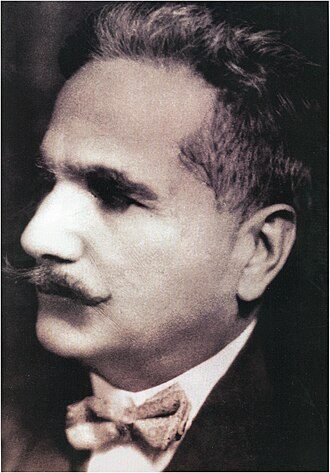
Allama Muhammad Iqbal
Sialkot-born poet and philosopher of Lahore whose 1930 Allahabad address called for the north-western provinces to be joined in one state; he also wrote a poem in praise of Guru Nanak.
Allama Muhammad Iqbal (1877 to 1938) was a poet, philosopher and lawyer, born at Sialkot and settled at Lahore. He wrote mainly in Urdu and Persian and is honoured in Pakistan as its national poet. In this record he matters for one speech: his December 1930 address to the Muslim League, which is read as the first public statement of the idea of a Muslim state in the north-west. That idea ended in the partition of Punjab in 1947. He also wrote with admiration of Guru Nanak.
Key moments
- 9 November 1877: born at Sialkot. He studied at Government College, Lahore (BA 1897, MA 1899), then at Trinity College, Cambridge, and took a doctorate at Munich; his thesis on the development of metaphysics in Persia was published in 1908.
- 1915 and 1924: published Asrar-i-Khudi in Persian and Bang-e-Dara in Urdu. The second contains the poem "Nanak", which calls Guru Nanak a mard-e-kamil, a perfect man who woke South Asia from its sleep, according to the Sikh Research Institute's reading of it.
- 1922 and 1926: knighted in 1922, and in 1926 won a seat in the Punjab legislature from Lahore's Muslim constituency, according to The Tribune.
- 1928 to 1931: Sirdar Kapur Singh recorded frequent visits to Iqbal's home in these years, the Sikh Research Institute reports.
- 29 December 1930: presidential address to the Muslim League at Allahabad. He said he would like to see Punjab, the North-West Frontier Province, Sind and Baluchistan "amalgamated into a single state", and described a consolidated north-western Muslim state as the final destiny of the Muslims of that region, whether within the British Empire or outside it. Wikipedia notes that some readers take him to mean a unit inside India, since he also spoke of "a Muslim India within India".
- 21 April 1938: died at Lahore. The Tribune reports that Hindus, Sikhs and Muslims of the city gathered after his death and asked that he be buried at the Lahore Fort. His tomb is at Hazuri Bagh, between the Badshahi Mosque and the Fort.
The Sikh side of the story: In March 1940 the Muslim League passed the Pakistan Resolution at Lahore. The Encyclopaedia of Sikhism records that this aroused intense Sikh opposition, because the Sikhs would become a permanent minority in a Muslim state, while any division of Punjab would also divide the Sikhs. In 1946 the Cabinet Mission itself warned that a partition of Punjab "would of necessity divide the Sikhs". When Punjab was partitioned in 1947, the Encyclopaedia records, West Punjab was emptied of Hindus and Sikhs within three months, and about three and a half million of them migrated to India.
Remembered for: Asrar-i-Khudi, Bang-e-Dara and the song "Saare Jahan Se Achha" written in 1904, and for the Allahabad address, which Pakistan treats as the root of its founding.
Sources
- Muhammad Iqbal, Wikipedia (used for education, works and the Allahabad address; no better single source loaded). en.wikipedia.org
- The legend of Sir Mohammad Iqbal (R. K. Kaushik, 23 April 2017), The Tribune. tribuneindia.com
- Allama Iqbal: Pakistan's national poet & the man who gave India 'Saare jahan se achha' (Ifrah Mufti, 9 November 2018), ThePrint. theprint.in
- The inevitable destination (essay quoting the Allahabad address, 2007), Marghdeen. marghdeen.com
- Allama Iqbal and the Sikhs (Harinder Singh, 9 November 2020), Sikh Research Institute. sikhri.org
- Partition of the Punjab (1947), The Encyclopaedia of Sikhism (ed. Harbans Singh), Punjabi University, Patiala. eos.learnpunjabi.org