Person
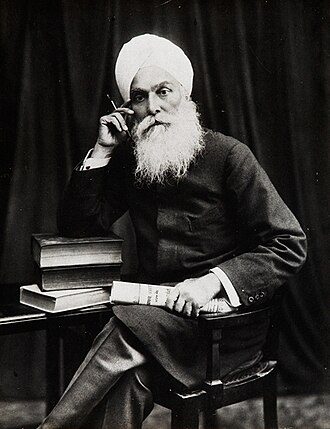
Bhai Kahn Singh Nabha
Singh Sabha scholar of Nabha who wrote Ham Hindu Nahin (1898) and the Mahan Kosh (1930), the great encyclopaedic dictionary of Sikh literature.
Bhai Kahn Singh of Nabha was born on 30 August 1861 at Sabaz Banera, in a Dhillon Jatt family, in what was then the territory of the ruler of Patiala. His father, Narain Singh, headed Gurdwara Dera Baba Ajapal Singh at Nabha. Kahn Singh never went to school or college, yet by the age of ten could recite both the Guru Granth Sahib and the Dasam Granth. He read Sanskrit classics with pandits, learnt music from Mahant Gajja Singh and studied Persian with teachers in Delhi.
In 1883 he went to Lahore and for two years helped Professor Gurmukh Singh, a leading figure of the Singh Sabha, in publishing his Sudharark. In 1887 he became tutor to Tikka Ripudaman Singh, heir of Nabha, and went on to hold posts in the Nabha state from the Maharaja's private secretary to High Court judge, with a short spell in Patiala from 1915 to 1917. In 1885 he met Max Arthur Macauliffe, who came to depend on his advice for his study of the Sikh scriptures and gave him the copyright of The Sikh Religion.
Main works
- Raj Dharam (1884), his first book, written at the request of the Maharaja of Nabha.
- Ham Hindu Nahin (1898), a dialogue between a Hindu and a Sikh which sets out texts from Sikh scripture to show that Sikh belief and conduct differ from Hindu tradition. It was registered in the Punjab Gazette on 30 June 1899. The Encyclopaedia of Sikhism calls it the most reasoned and convincing of the many tracts of the time on the question.
- Gurmat Prabhakar (1898), a glossary of Sikh terms, and Gurmat Sudhakar (1899), an anthology of scriptural and historical texts.
- Gurushabad Ratnakar Mahan Kosh (1930), his best-known work.
The Mahan Kosh carries 64,263 entries drawn from the Sikh canon and from Sikh history. He resigned his post in the Nabha government on 10 May 1912 to begin it, took about fourteen years, and finished the manuscript on 6 February 1926. Printing began at Amritsar on 26 October 1927 and ended on 13 April 1930, in four volumes, with the cost underwritten by Maharaja Bhupinder Singh of Patiala after earlier patrons died or lost their thrones.
What he is remembered for: Ham Hindu Nahin answered the argument, made by some Hindus and by some Sikhs, that Sikhism was part of Hinduism, a view the Encyclopaedia links to an 1897 address by Baba Sir Khem Singh Bedi. The Mahan Kosh remains the standard reference on Sikh language and history. The Encyclopaedia says that from the privacy of his study he subtly moulded the Sikh awakening at the turn of the century. He died at Nabha on 24 November 1938.
Sources
- Kahn Singh of Nabha (1861-1938), The Encyclopaedia of Sikhism (ed. Harbans Singh), Punjabi University, Patiala. eos.learnpunjabi.org
- Gurushabad Ratanakar Mahan Kosh, The Encyclopaedia of Sikhism (ed. Harbans Singh), Punjabi University, Patiala. eos.learnpunjabi.org
- Ham Hindu Nahin, The Encyclopaedia of Sikhism (ed. Harbans Singh), Punjabi University, Patiala. eos.learnpunjabi.org
- Singh Sabha Movement, The Encyclopaedia of Sikhism (ed. Harbans Singh), Punjabi University, Patiala. eos.learnpunjabi.org