Person
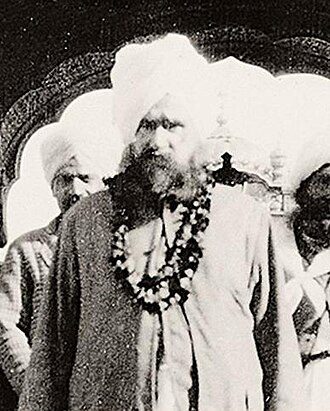
Sardar Arur Singh
Government-appointed sarbarah of Sri Harmandir Sahib and Sri Akal Takht Sahib who ordered the idols out of the parikrama in 1905, honoured General Dyer in 1919 and resigned in August 1920.
Sardar Arur Singh (1865 to 1926) of the Shergill family of Naushahra Nangli, Amritsar district, was the sarbarah, or manager, of Sri Harmandir Sahib and Sri Akal Takht Sahib under British appointment. His father, a deputy superintendent of police, died when he was about four. He was raised under the Court of Wards, took the family estate in 1885, became an honorary magistrate in 1888 and received a CIE in 1913 (Encyclopaedia of Sikhism). He is not the Arur Singh of Kohala who attended Maharaja Duleep Singh in 1886.
The start of his tenure is given differently. Wikipedia says he was appointed on 1 July 1902 to succeed Colonel Jawala Singh. The Encyclopaedia of Sikhism dates his term from 1907 to 1920, and says the government appointed him despite the reformers' demand that the Sikh community choose the sarbarah. Sheena Pall's paper in the Journal of Punjab Studies, citing Punjab State Archives files, shows him already acting as manager in May 1905.
Key moments
- 1 May 1905: he ordered that Brahmans stop sitting in the parikrama with idols for worship, and stop washing clothes, spitting or rinsing their mouths in the sarovar. They could still bathe, perform puja and apply tilak. Hindus of Amritsar met on 4 May and protested. On 6 May the Brahmans returned with the idols, he reported it to the police, and a second order of 7 May was finally complied with. Petitions continued for over a year, including one signed by 13,000 Hindus and Sikhs (Pall).
- 1919: after the Jallianwala Bagh massacre of 13 April, he and the priests of Sri Darbar Sahib publicly honoured General Dyer (Encyclopaedia of Sikhism). The Tribune, citing Prof Mohinder Singh's The Akali Movement, describes a siropa at the Akal Takht and a conversation in which Dyer declined to become a Sikh, citing long hair and smoking.
- August 1920: under growing demands for his removal he resigned, on 29 August according to Wikipedia. At a meeting at Jallianwala Bagh in August 1920 he publicly apologised for what he had done and left undone in running the shrines (Encyclopaedia of Sikhism).
- 1 January 1921: the government knighted him, as Sardar Sir Arur Singh, KCIE.
The Encyclopaedia adds that rumours he set aside valuable gifts from the treasury for British officers led to an agitation that came to nothing, and that later complaints of mismanagement and corruption were rejected.
The Tribune reports (July 2022) that Simranjit Singh Mann is his maternal grandson. Mann has defended the honour to Dyer, saying his grandfather acted to save the Golden Temple from aerial bombing on the advice of G. A. Wathen, then principal of Khalsa College. The Tribune did not verify that claim. It calls the honour to Dyer a black chapter in Sikh history.
He is remembered as the sarbarah whose conduct showed what it meant for the Panth's central shrines to be run by a government appointee.
Sources
- Arur Singh, Sardar Bahadur Sir (1865-1926), Encyclopaedia of Sikhism, Punjabi University. eos.learnpunjabi.org
- Simranjit Singh Mann defends grandfather who honoured General Reginald Dyer (17 Jul 2022), The Tribune. tribuneindia.com
- Issues of Sikh Identity: Sanatanist-Sikh Debate, Journal of Punjab Studies 20, Sheena Pall, University of California. punjab.global.ucsb.edu
- Arur Singh Shergill, Wikipedia. en.wikipedia.org
- Arur Singh (the attendant of Maharaja Duleep Singh), Encyclopaedia of Sikhism, Punjabi University. eos.learnpunjabi.org