Person
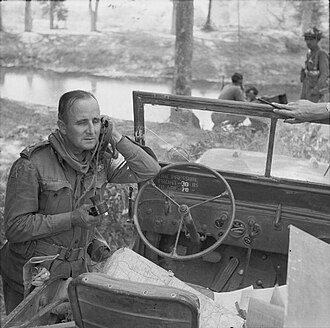
Major-General Thomas Wynford Rees
British Indian Army general who commanded the Punjab Boundary Force in August 1947, the mixed force that failed to stop the killing in central Punjab and was disbanded after about a month.
Major-General Thomas Wynford Rees, known as "Pete" Rees, was the British Indian Army officer who commanded the Punjab Boundary Force, the mixed army force meant to keep order in central Punjab while the province was divided in August 1947. It could not do it, and it was broken up after about a month.
He was born on 12 January 1898 in Cardiff and was commissioned into the Indian Army in November 1915. He won the Military Cross and the Distinguished Service Order in the First World War, commanded the 19th Indian Division from 1942, led it in Burma in 1944 and 1945, and earned a bar to his DSO. Field Marshal Slim called him a dynamic commander. He died on 15 October 1959.
Key moments
- 17 July 1947: the Punjab Boundary Force was set up with its headquarters at Lahore, under Rees, with Brigadier D. S. Brar for India and Brigadier M. Ayub Khan for Pakistan as military advisers. It began operating on 1 August 1947.
- The Encyclopaedia of Sikhism says it was assigned twelve districts of central Punjab, with about 14.5 million people in nearly 18,000 towns and villages across 37,500 square miles, and calls it a force of over 50,000 Indian troops. The figures differ by source: Wikipedia counts about 15 Indian and 10 Pakistani battalions, and one document noted in a Cambridge article gives seven brigades and 23,000 troops.
- The Encyclopaedia lists what went wrong. The force was at first well under strength, the monsoon hampered it, it had no proper intelligence system, the civil administration had broken down, the Punjab police were partisan or afraid to act, and some troops gave way to communal loyalties. It could do little more than slightly check the killing and prevent a complete holocaust at Lahore and Amritsar.
- Wikipedia says Rees refused his advisers' advice and rebuked Brigadier Thimayya over their age difference. At the Joint Defence Council in Lahore on 25 August he reported that the force was exhausted and urged the two dominions to take over the security of the refugees.
- The force was disbanded, the Encyclopaedia says on 31 August and Wikipedia and the Cambridge article on 1 September, so that the new Indian and Pakistani armies could take charge. Politicians on both sides criticised the force's neutrality.
What he is remembered for: the failure of the Boundary Force. When it went, the two new governments took over the forces on their own sides of the line. Robin Jeffrey's study of the force cites Rees's own Report on the Punjab Boundary Force and thanks his son for lending his papers.
Sources
- Partition of the Punjab (1947) (entry by Penderel Moon), The Encyclopaedia of Sikhism (ed. Harbans Singh), Punjabi University, Patiala. eos.learnpunjabi.org
- The Punjab Boundary Force and the Problem of Order, August 1947 (Robin Jeffrey, Modern Asian Studies 8:4, 1974), Cambridge University Press. cambridge.org
- Punjab Boundary Force, 1947 Partition Archive. in.1947partitionarchive.org
- Thomas Wynford Rees (used for his life and the force's command details, where no better source loaded), Wikipedia. en.wikipedia.org
- Punjab Boundary Force (used for the advisers, battalions and the 25 August meeting, where no better source loaded), Wikipedia. en.wikipedia.org