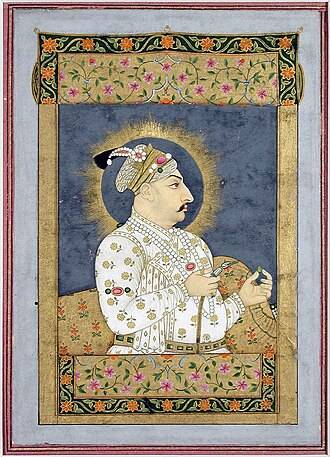
Muhammad Shah Rangila
ਮੁਹੰਮਦ ਸ਼ਾਹ ਰੰਗੀਲਾ
Thirteenth Mughal emperor (1719 to 1748), who lost Delhi to Nader Shah in 1739 while his Lahore governors hunted the Sikhs; the Chhota Ghallughara of 1746 fell in his reign.
Muhammad Shah (born Roshan Akhtar, 1702 to 1748), nicknamed Rangila, "the Colourful", was the thirteenth Mughal emperor and reigned from September 1719 to April 1748. His reign matters for Punjab for two reasons. The Mughal state lost its hold on the north-west under him, and it was his governors at Lahore who carried out some of the worst years of persecution of the Sikhs before the Khalsa rose to power.
He came to the throne as a teenager, chosen and closely watched by the Sayyid brothers, and later removed them with the help of Nizam-ul-Mulk, Asaf Jah I, according to Wikipedia. It describes him as a patron of music and the arts.
Key moments
- 1726: Zakariya Khan succeeds his father as governor of Lahore. The Encyclopaedia of Sikhism says he launched a still severer policy against the Sikhs.
- 1733 to 1735: Zakariya Khan offers the Sikhs the title of Nawab and a jagir, then occupies the jagir within two years and resumes the hunt.
- Through his governorship: Zakariya Khan lays down rewards of a blanket for cutting a Sikh's hair, ten rupees for information and fifty rupees for a scalp, and Bhai Mani Singh and Bhai Taru Singh are beheaded at Lahore's horse market, renamed Shahidganj by the Sikhs.
- Early 1739: Nader Shah of Iran defeats Muhammad Shah's army at Karnal and, the Tribune (2000) says, occupies the Delhi fort on 9 March. The same article says Nader Shah took the Koh-i-Noor on 1 May 1739 by a turban exchange, after Muhammad Shah had hidden the diamond in his turban.
- 22 March 1739: the massacre in Delhi, after which Wikipedia says Muhammad Shah and Asaf Jah I begged for mercy. Wikipedia and Dawn give 20,000 to 30,000 dead; a 2023 Tribune article repeats a far higher figure, over two lakh, as something people "were said" to have counted.
- Summer 1739: on Nader Shah's return through Punjab, Sikh bands plunder his baggage train, according to the Encyclopaedia of Sikhism. It also notes that Anand Ram Mukhlis, secretary to Muhammad Shah's chief minister, does not mention the Sikhs at all in his account of the invasion.
- 1 July 1745: Zakariya Khan dies. In March to May 1746 his successor Yahiya Khan and the minister Lakhpat Rai launch the Chhota Ghallughara, in which an estimated 7,000 Sikhs are killed and 3,000 captured.
- 1748: Ahmad Shah Durrani makes his first invasion; Muhammad Shah dies in Delhi that April.
Remembered for: the decay of Mughal power after Aurangzeb, the loss of Delhi to Nader Shah, and an era in which his governors tried and failed to destroy the Sikhs. The Encyclopaedia of Sikhism says Zakariya Khan remained unsuccessful in his object and died a dispirited man, leaving his sons chaos and confusion.
Back to ThreadsSee its threads
Sources
- Muhammad Shah, Wikipedia (used for dates and the Sayyid brothers; no better single source loaded). en.wikipedia.org
- Zakariya Khan (d.1745), The Encyclopaedia of Sikhism (ed. Harbans Singh), Punjabi University, Patiala. eos.learnpunjabi.org
- Chhota Ghallughara, The Encyclopaedia of Sikhism (ed. Harbans Singh), Punjabi University, Patiala. eos.learnpunjabi.org
- Tazkirah (lit. memoir), The Encyclopaedia of Sikhism (ed. Harbans Singh), Punjabi University, Patiala. eos.learnpunjabi.org
- Taruna Dal, The Sikh Encyclopedia (web edition of the Encyclopaedia of Sikhism). thesikhencyclopedia.com
- The scourge of Delhi (Irfan Husain, 24 January 2009), Dawn. dawn.com
- This Diamond Is Forever (Gurmukh Singh Sandhu, 9 July 2000), The Sunday Tribune. tribuneindia.com
- How the famed Koh-i-Noor kept changing hands (June 2023), The Tribune. tribuneindia.com