Person
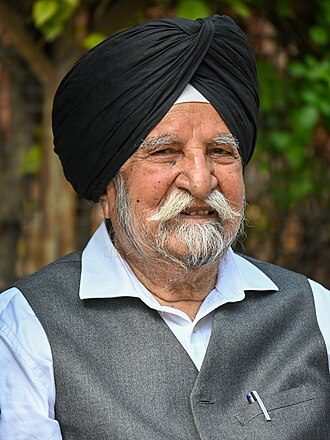
Dr Sardara Singh Johl
Punjab agricultural economist, former Vice-Chancellor of Punjab Agricultural University and Punjabi University, known for his plan to move farmers out of the wheat and paddy rotation.
Dr Sardara Singh Johl is one of Punjab's best-known agricultural economists. The Tribune gives his birth as 2 August 1928, to a farming family in Lyallpur district, then in undivided Punjab and now in Pakistan. He took his degrees in agriculture, agricultural economics and economics at Panjab University. In 1952 he began agriculture and rural development work in hill areas, which he continued for more than eight years. He then joined Punjab Agricultural University, Ludhiana, where he became Professor and Head of the Department of Economics and Sociology in 1965.
Wikipedia lists him as Vice-Chancellor of Punjab Agricultural University and of Punjabi University, chair of the Commission for Agricultural Costs and Prices, and, from 2012, the first Chancellor of the Central University of Punjab. He received the Padma Bhushan in 2004.
The Johl reports
- 1986: his report on the diversification of agriculture in Punjab. The Tribune wrote in August 2003 that it was never implemented: a drought of about six years from 1987 and rising support prices pushed farmers to grow more wheat and rice.
- 2002: as Vice-Chairman of the Punjab State Planning Board and head of the Chief Minister's Advisory Committee on Agriculture Policy, he proposed a crop adjustment programme. His interim report went in during July and, the paper reported, sat for about two and a half months in a Financial Commissioner's office. On 29 October he submitted the final report together with his resignation, in protest. The Chief Minister reportedly refused to accept it.
- The plan: move about one million hectares out of the rice and wheat rotation into oilseeds and pulses, pay farmers Rs 12,500 a hectare, and seek Rs 1,280 crore from the Centre. He estimated a saving of at least Rs 3,720 crore a year, mainly from lower procurement and buffer-stock costs, and said it would ease pressure on soil and water.
- August 2003: the Centre had not backed the plan. Union officials treated the payments as a subsidy. The economist H. S. Shergill criticised it, and Johl rejected the criticism. The Tribune described him as fighting a lonely and losing battle.
- August 2022: named patron of the Sikh Forum, Amritsar.
He is remembered for the Johl plan and for his argument, from 1986 to 2003, that Punjab had to break out of its rice and wheat rotation.
Sources
- Grit, hard work won him Padma Bhushan, The Tribune, 24 January 2004. tribuneindia.com
- Punjab fights a losing battle on Johl plan, The Tribune, 11 August 2003. tribuneindia.com
- Report on Dr S.S. Johl's resignation as Vice-Chairman of the State Planning Board, The Tribune, 7 November 2002. tribuneindia.com
- Sikh Forum elects office-bearers, The Tribune, August 2022. tribuneindia.com
- Sardara Singh Johl, Wikipedia (used for the Vice-Chancellorships, the commission and the Central University of Punjab). en.wikipedia.org